Showing posts with label ayahuasca. Show all posts

Monday, February 4, 2013

Stepping Into The Fire (full ayahuasca documentary)


Stepping Into the Fire is the cinematic release that reaches into the ash of the bare bones of existence and asks the question "is humanity born to die, or is humanity born to live?" The film follows the true story of three successful individuals brought together by an ancestral medicine from South America that has become legendary for its miraculous and profound effects. 

Ayahuasca -- as the Amazonian brew is known -- is well known for its mental, physical and energetic healing properties. Stepping Into the Fire closely examines the life-changing effects Ayahuasca can have and illustrates why environment and health are so crucial to human success on a global scale.

Stepping Into the Fire features Roberto Velez, Donna Walsh, Bo and José Pineda Varges (a.k.a Maestro Mancoluto). The story begins with Roberto Velez -- a high-level New York Stock Exchange trader -- raised since adolescence in America, but ultimately of Peruvian descent. In the peak of his career, Velez finds himself seeking; unable to reconcile his material gains with the lack of direction and depth in his life. 


With nowhere else to turn, Velez scours Peru -- the land of his ancestors -- only to find Mancoluto, a first-level master shaman descended from one of the earliest civilizations in Amerindian history, Chavin. Mancoluto's expertise in natural health, particularly in the case of two ancestral medicines known as Ayahuasca and Huachuma, provides him a unique lens when treating Velez's predicament. Once this connection was made, countless other pieces start falling into place and a center for ancient Peruvian healing arts is quickly born.

cybershamans (karmapolice) / CC BY-NC-ND 3.0
Share/Bookmark

Tuesday, October 25, 2011

TRADUS-Alte lumi - Calatorie in inima samanismului 1/6


Share/Bookmark

Tuesday, July 12, 2011

Irish Soma


By Peter Lamborn Wilson

Many scholars believe that the Indo-Europeans used an entheogenic or psychedelic drug in their rituals -- called soma amongst the Vedic people of India, and haoma in Iran. The ancient Greeks also used an ergot-based preparation in wine as the entheogenic trigger of the Eleusinian Mysteries.

Soma has been identified as amanita muscaria or the fly agaric mushroom; haoma may have been the same, or it might be "wild rue," a harmaline-containing shrub (see Bibliography under Flattery and Schwartz). If there's any truth to these theories, we would expect to find that other Indo-European peoples also used such drugs shamanically or ritually.

Terrence McKenna believes that psilocybe was once even more widely distributed than it is now, and therefore must also be considered in the soma context. Certainly entheogenic religions are far more thoroughly attested today than when Wasson launched ethnomycology with his "wild" speculations, which now seem rather conservative.

Even if we cannot accept the "psychedelic experience" as the origin of religion, I believe that we must certainly see it as one of a complex of "origins", a complexity which might best be expressed in a palimpsest of theories about those origins.

In short, I would maintain that the failure to consider entheogenesis ("birth of the god within" by ingestion of psychotropic substances) must be considered a serious flaw in any integral History of Religion.

I consider it strange that in all the writing I've read about psychedelics, and about Ireland, not one text has connected the two subjects. My reading is of course far from complete, and my first query concerns this point. I can scarcely believe that I'm the first to consider the question of a soma cult amongst the Celts, those old-fashioned Indo-Europeans so loyal to ancient ways -- and so fond of intoxication.

An immediate presumption would be that the Celts lost soma, if they ever had it, when they migrated West from the Indo-European heartland; at best, they may have developed mead as a substitute. I know of no reference to intoxicants other than alcohol in use among the Celts, who in fact quickly became major importers of Mediterranean wines.

We know, however, that a vast amount of orally-transmitted Druid lore is lost beyond recall, and we als/o know how entheogenic cults can thrive under the very nose of "civilization" and not be noticed (as in Latin America).

Wasson and his school have demonstrated how mushroom language tends to be euphemized, masked, coded, buried in etymologies and even "false" etymologies. If we are to speculate about the possible existence of a Celtic -- specifically Irish -- soma, we must exercise a bit of detective work. Using some of their findings as possible structures for our exegesis, we can go back and read our texts over again and hope for a few glimmerings or clues.

Irish myths and legends were not written down till the Christian era, and then only by monks who might well have misunderstood or even censored any references to a soma-type substance or cult. By that time, any entheogenic knowledge or ritual once possessed by druids might well have already vanished (or retreated into folklore), and the memory of soma distorted beyond recognition.

Any mushroom lore that survived till the ninth to twelfth centuries A.D. would be the province of illiterate peasant wise-women and wizards -- not of literate monks. For this reason we can expect that the myths and legends of the monkish manuscripts will be hard to read from our special perspective. But Irish folklore, as distinct from myths and legends, may prove a much clearer source.

For reasons known to folklorists, Ireland is a special case of the survival of Indo-European lore, comparable perhaps only to India. In fact, Indian material should be used to throw light on Irish material where areas of darkness exist. From this point of view I think we can take for granted that whatever we may find in Ireland that looks like soma, and smells like soma, so to speak, might very well be soma, although we may never be able to prove the identity. But the well-known affinity between Celtic and Vedic cultures should pre-dispose us to at least a certain open-mindedness.

The Irish material abounds in references to magical substances which bestow knowledge and/or pleasure when ingested. Perhaps the best-known are the hazelnuts of wisdom, eaten by the Salmon, fished up by the Druid, and cooked by young Finn--who, as "sorcerer's apprentice", burns his thumb on the Salmon's skin, sticks thumb in mouth, and attains all the wisdom in his master's stead.

The "shamanic" overtones of this story are quite obvious. Turning to the older manuscripts, we have the enigmatic "Geste of Fraoch" [1], concerning the hero Fraoch who is half-fairy (Sidh) in origin. His sister is the nymph of the River Boyne. He seeks to marry Find-abair, daughter of Aillil and Maeve, the witch-queen.

He arrives at their kingdom with his retinue and impresses everyone with his beauty, and his skill at music and chess. Find-abair falls in love with him. They meet secretly and she gives him her gold thumb-ring. Aillil and Maeve agree to the wedding, but secretly plot the hero's destruction. Maeve invites Fraoch to bathe in her magic spring.

Growing on its bank is the rowan tree.

Every fourth and every month
Ripe fruit the rowan bore:
Fruit more sweet than honey-comb;
Its clusters' virtues strong,
Its berries red could one but taste
Hunger they staved off long.

Rowan Berry juice could preserve life and cure dread disease. Maeve, sitting on the shore, begs Fraoch to swim over and pluck some berries for her. As she well knows, the rowan-berries are guarded by a dragon (or water-serpent), who attacks Fraoch. In one version, the beast kills him.

In another version, as Maeve, her daughter, and the court ladies enjoy the sight of Fraoch sporting naked in the pool, Aillil steals the gold thumb-ring from Fraoch's purse, shows it to Maeve, and throws it into the water. Fraoch notices this, and also notices that a salmon gulps down the ring.

Without anyone seeing him, he catches the fish barehanded, and hides it "a hidden spot by the brink" of the water. Thereupon Maeve demands the rowan-berries; Fraoch complies; the monster appears. Find-abair strips to the buff and leaps into the water with a sword, which she tosses to her lover. He slays the beast. Aillil and Maeve now plot the death of their own daughter.

A ritual bath is prepared for Fraoch, "of fresh-bacon broth and heifer-flesh minced in it," a sign that he will be raised to royal status. Afterwards a feast is organized. During the feast Aillil orders that all his treasures be brought out and displayed.

In order to complete this vulgar show, he demands that Find-abair produce her gold thumb-ring; when she fails to do so he threatens her with death. But Fraoch has meanwhile retrieved the salmon from its hiding-place and given it to Find-abair's maid to cook. The girl brings in the fish, "broiled..., well prepared with honey dressing." The ring is of course discovered. Aillil and Maeve are foiled.

In this version the tale ends happily. Ignoring the temptation to unpack too many clues from this story, we should confine ourselves to asking whether or not it can be read for possible ritual content.

The sacred pool, the sacred tree, the combat (which can be seen as a sacrifice, either of Fraoch or of a substitute, the salmon, or of the monster), the beef-and-bacon bath -- during which a chorus of fairy women (Fraoch's sister Boyne and her maidens) appear and sing. All these motifs suggest that our legend is (at least in part) a masked ritual.

In that case, the berries may also have a ritual significance. The salmon (with honey) and the thumb ring remind us of the shamanic complex again. The old manuscripts also preserve a number of imrama, or sea-going voyage-tales: the voyages of St. Brendan, of Bran, of Maeldun, and of the O'Corra brothers.

The sailors in these romances find many marvelous islands, and on some of these islands they find marvelous fruits -- some poisonous, some euphoriant, and some which stave off hunger. In "the voyage of the sons of O'Corra," for example, they visit an island whose trees are "laden with fruit, and the leaves dropped honey to the ground.

In the midst of the island was a pretty lake, whose waters tasted like sweet wine. But after a week of rest by its shores, a "monstrous reptile rose up from the lake, and looked at them." The monster, however, disappears without harming them. [2]

Maeldun and his crew also experience an "Isle of Intoxicating Wine Fruits:"

They were now a long time tossed about on the great billows, when at length they came in view of an island with many trees on it. These trees were somewhat like hazels, and they were laden with a kind of fruit which the voyagers had not seen before, extremely large, and not very different in appearance from apples, except that they had a rough, berry-like rind.

After the crew had plucked all the fruit off one small tree, they cast lots who should try them, and the lot fell on Maildun. So he took some of them, and, squeezing the juice into a vessel, drank it. It threw him into a sleep of intoxication so deep that he seemed to be in a trance rather than in a natural slumber, without breath or motion, and with the red foam on his lips.

And from that hour till the same hour next day, no one could tell whether he was living or dead. When he awoke next day, he bade his people to gather as much of the fruit as they could bring away with them; for the world, as he told them, never produced anything of such surpassing goodness.

They pressed out the juice of the fruit till they had filled all their vessels; and so powerful was it to produce intoxication and sleep, that, before drinking it, they had to mix a large quantity of water with it to moderate its strength.
St. Brendan seems to have visited the same island but, being a saint, he failed to experience the deep trance and euphoria of the more worldly Maeldun. [3] Note that the color of the magic substance is usually red. Even hazelnuts are "reddened" by association with salmon-flesh.

Maeldun sees red apple-like or nut-like fruit with a rough rind -- which could be an accurate description of a fly-agaric "toadstool" or its dried cap. Maeldun's squeezing of the juice reminds us directly of Vedic soma-ritual, and the warning to cut the juice with water reminds us of the Greek injunction to mix certain "wines" twenty-to-one with water, lest they be too powerful -- obviously not wine as we now know it, as C. Ruck points out in Persephone's Quest. [4]

Persephone's Quest is the book which sparked my intention to draft this query. The specific impetus rose from Ruck's brilliant essay on "The Offerings from the Hyperboreans," i.e., the votive offerings sent from the semi-mythical land of Hyperborea to Apollo's shrine oracle at Delos.

In this text, Ruck makes no mention of the often-repeated but not very convincing identification of Hyperborea as Ireland, or the insular-Celtic lands in general. The route taken by the offering (a sheaf of wheat hiding some other plant, apparently), is traced by three ancient authors, who all place Hyperborea beyond the Danube and beyond Scythia, near the Altai Mountains.

This might locate Hyperborea somewhere near the vague (and controversial) origin-point of the Indo-Europeans and hence of the Celts. A Siberian origin for the Indo-Europeans is strengthened by Vedic references and a mass of other material which must not detain us here.

Suffice to say that the "Hyperboreans" are very close to the area in which A. muscaria still provides the entheogenic juice for shamanic practice. Ruck marshals a great deal of circumstantial evidence to identify the offerings as fly agaric, dried and wrapped in straw.

A possible historical connection between Hyperborea and the Celts, however fascinating, will not serve our purpose so well, however, as Ruck's discussion of a certain tribe living along the route of the offerings and involved with their delivery, the Arimaspeans.

Their name, in the Scythian language, supposedly describes them as a one-eyed people, akin to gorgons and griffins. A number of other one-eyed and/or one-legged races appear in the story of Apollo and the Hyperboreans--for example, the Telchines, magic metallurgists "with a reputation for sorcery and drugs" [5], masters of herbalism and the "evil eye". Ruck explains:

"The fungus of the Hyperborean homeland would have come ... from the wooded slopes of the Altai Mountains, where conifers and birch abound, an environment, therefore, where Amanita muscaria is commonly found.

Presumably, it would have fruited in the autumn and been preserved by drying so that it could be conveyed over the long journey, wrapped in straw, to arrive on Delos in late spring along with the other offerings of first fruits. Is there anything, we must now ask, in the Apolline traditions that might suggest that this was the identity of the secret plant?

The one-eyed Arimaspeans, who, as we have seen, were either just another name for the Hyperboreans or, as a separate people, were the first intermediaries in the transmission of the subterranean gold that was mined by the griffins. [They] are a personification of one of the attributes of soma as the "single eye."

So, therefore, are the Cyclopes, whose murder as primitive surrogate occasioned Apollo's expiatory sojourn amongst the people of his northern homeland. There were two versions of these Cyclopes, and the Anatolian ones probably arose from a separate dissemination of the metaphor through Asia Minor, where the later discredited Lycian Telchines display the same attribute as their evil eye.

These one-eyed creatures are a variant of another attribute of soma as the figure with a single foot, a characteristic of a supposed race of people called the Shade-foots, who came from the Indus valley and were fancifully implicated, according to Aristophanes6 in a profane celebration of the Lesser Eleusinian Mystery.

It appears that the Arimaspeans may have come from the same general region, for Herodotus's supposed Scythian etymology of their name is probably not correct, but they were really an Iranian tribe, called the Argempaioi or Argimpasoi. All these fabulous creatures can be traced to fungal manifestations and testify strongly that it was some kind of mushroom, if not actually Amanita, that was originally the Hyperborean plant.

In its Hesperidean version, the plant bears still another attribute of soma as the 'mainstay of the sky', which is the role that Atlas plays as 'pillar of heaven' in the west [7], just as his Titanic brother in the east, Prometheus, when presented as a Shade-foot, impersonates the sacred plant as a "parasol," which is the same Sanskrit word as mushroom. The single-footed trait can also be seen in certain Greek heroes who, like Oedipus, have mythical roles as Apolline surrogates."

The Shade-foots were also known as Monocoli or "One-legs". [8] This latter name is particularly interesting because when we find these people in modern times, they will be a particular plant involved in Asiatic shamanism.

Monocoli in Greek was an epithet of plants. In modern times, the prodigious strength of their single leg will also be remembered from ancient traditions.

In his own essay, "Persephone's Quest," Wasson also discusses a number of one-eyed, one-footed beings from various folkloric and iconographic sources, including the Cyclopes, and soma itself, which is described in Vedic Sanskrit as Aja Ekapad, "Not-born Single-foot."

Mushrooms are "not born" because they have no seed; they are caused by lightning bolts. And mushrooms are single-footed, of course. The penis is the "one-eyed serpent," and the mushroom is a penis. Folklore can be scoured endlessly to rake up further examples; Wasson's point is that one-eyed one-legged beings are to be decoded as mushrooms, at least in certain contexts.

The Irish also have a one-legged one-eyed race in their past: the Fomoire or Fomorians. In some legendary histories they seem to be the very oldest inhabitants of the island, but still they come from elsewhere, either "from the sea" (but "sea" is probably a false etymology for their name, fomorian); or else they invaded Ireland from Africa.

In some tales the Fomorians live under the sea (like Chinese dragons) or else more prosaically on Tory Island. Sometimes they are giants, and moreover they can appear as one-eyed one-footed giants. Sometimes they appear to be a race of wizards, "human" enough to inter-marry with the Tuatha de Danaan (who, however, aren't all that human themselves).

In fact the half-breed King Bres, who causes war between the two races10 is described as the most beautiful youth in Ireland -- even though the Fomoire are usually depicted as ugly, low, hideous, deformed, etc.

One gets the impression that the Fomorians represent a pre-Celtic Irish race, and that we are seeing them through the texts of the Celts, who invaded their land and subdued them, and now wish to present them as villains, boors, snake-worshippers, or even nonhuman monsters. This is a universal theme in folklore, which often seems to harbor memories of an archaic "us/them" situation.

Ultimately it may lead us back to the emergence of agricultural peoples and their "conquest" and enslavement of hunter/gatherer tribes -- i.e., back to the very beginnings of civilization and history.

The Fomorians, who are connected with the megaliths by folklore, and who survive to play roles as ogres and giants in Irish fairy tales, may have been remnants of the great Atlantic Megalithic peoples, who created the culture of New Grange and Stonehenge long before the Celts arrived in Europe.

The marginalized "race" or "caste" survives as tinkers (primitive metallurgists, perennial outsiders), minstrels, vagabonds, fortune-tellers, herbalists, servants, grooms, prostitutes, wizards. Much later in history the Celts will undergo the same marginalization by new "invading races"--the Fomorization of the Celts, as it were.

What interests us here, however, is not the fate of the Fomorians but their special role as one-eyed shade-foots -- i.e., their role in folklore. Whatever their other qualities in history, myth, or legend, they are clearly "Arimaspeans", and hence are to be suspected of kinship with mushrooms.

And if hazelnuts, or red berries, are used to "mask" the mushroom in Irish tradition, we should look for Fomorians lurking somewhere in the underbrush near the sacred tree.

Just such a conjunction occurs in the saga of Dermat and Grania, which in turn forms part of the Finnian Cycle. [11] The hero and heroine are fleeing from the jealous wrath of Finn himself. Their flight takes them all over Scotland and Ireland, where many dolmens are still called "beds" of Dermat and Grania.

At one point they come to the Forest of Dooros (a name containing the Celtic word for "oak" and thus identifiable as a druid grove) in the district of HyFicra of the Moy (later known as the barony of Tireagh, in Sligo). At this time the forest was guarded by Sharvan the Surly, a giant of Lochlann.

"Now this is the history of Sharvan the Surly, of Lochlann. On a certain occasion, a game of hurley was played by the Dedannans against the Fena, on the plain beside the Lake of Lein of the Crooked Teeth.

They played for three days and three nights, neither side being able to win a single goal from the other during the whole time. And when Dedannans found that they could not overcome the Fena, they suddenly withdrew from the contest, and departed from the lake, journeying in a body northwards.

The Dedannans had for food during the game, and for their journey afterwards, crimson nuts and arbutus apples and scarlet quicken berries, which they had brought from the Land of Promise. These fruits were gifted with many secret virtues; and the Dedannans were careful that neither apple nor nut nor berry should touch the soil of Erin.

But as they passed through the Wood of Dooros, in Hy Ficra of the Moy, one of the scarlet quicken berries dropped on the earth; and the Dedannans passed on, not heeding. From this berry a great quicken tree sprang up, which had the virtues of the quicken trees that grow in Fairyland.

For its berries had the taste of honey, and those who ate of them felt a cheerful flow of spirits, as if they had drunk of wine or old mead; and if a man were even a hundred years old, he returned to the age of thirty, as soon as he had eaten three of them.

Now when the Dedannans heard of this tree, and knew of its many virtues, they would not that any one should eat of the berries but themselves; and they sent a Fomor of their own people to guard it, namely Sharvan the Surly, of Lochlann; so that no man dared even to approach it.

For this Sharvan was a giant of the race of the wicked Cain, burly and strong; with heavy bones, large thick nose, crooked teeth, and one broad, red, fiery eye in the middle of his black forehead. And he had a great club tied by a chain to an iron girdle which was round his body.

He was, moreover, so skilled in magic that fire could not burn him, water could not drown him, and weapons could not wound him; and there was no way to kill him but by giving him three blows of his own club. By day he sat at the foot of the tree, watching; and at night he slept in a hut he had made for himself, high up among the branches"

The Fena or Finnians or followers of Finn are Milesians, the last Iron Age Celts to arrive in Ireland. The Tuatha De Danaan are an earlier people, perhaps also Celtic but Bronze Age. The De Danaan have magical power, and after their final defeat by the Milesians they will retire into the megalithic mounds, such as the Brugh na Boine at Newgrange (which in this tale is the Castle of Angus, the god of love, patron of Dermat and Grania).

They are in fact the fairies.
The land of Promise or Land of Youth or Tirnanog, etc., is the mundus imaginalis or fairyland, Isles of the Blessed, Hy Brasil, etc. -- the spirit land where the De Danaan are also "at home". This is the origin of the various "crimson nuts and arbutus apples and scarlet quicken berries," which are not native to Ireland but to the "other world," the place where shamans go in trance.

The quicken tree is the "quicken beam or mountain ash, or roan-tree; Gaelic Caerthainn," a tree holy to the druids. The tree with its red fruit guarded by a giant recalls the Golden Fleece and the Golden Apples of the Hesperides; it is thus the world-axis, the shamanic ladder, and also the tree beneath which one finds fly agaric.

It is the beanstalk, Alice's tunnel to Wonderland, and all other liminal structures or gateways between levels. The fruit of the tree, like that of the tree of the knowledge of Good and Evil in Genesis, is the principle of transformation and realization; it is the sacrifice; and it is soma. This will become more clear as the tale unfolds.

Dermat makes a peace-pact with Sharvan the Surly: refuge in the Forest, so long as Dermat keeps his hands off the quicken berries. For a while all goes well. Meanwhile, Finn receives an offer of fealty from two former enemies, the sons of Morna. Before he forgives them, however, he demands an erc, or blood-price: either "the head of a warrior, or the full of my hand of the berries of a quicken tree."

Finn's son Oisin takes pity on the sons of Morna and explains the situation to them; nevertheless they undertake the quest and set out for the Forest of Dooros. Dermat easily overcomes them. Meanwhile Grania has developed an overwhelming obsession with the berries: she must taste them, or perish.

Reluctantly Dermat sets out to find Sharvan, taking the sons of Morna along as witnesses. The giant is asleep; Dermat whacks him on the head and rouses him. The hero asks for berries, the Fomor refuses. They fight a ferocious duel, and Sharvan is slain by three blows of his own club (just as the soma was sacrificed by pressing or "wounding" the plant).

Dermat orders the sons of Morna to bury the corpse while he goes to fetch Grania.

Dermat then satisfies Grania's desire, and also gives berries to the sons of Morna, who thank him profusely for sparing their lives, and set off to return to Finn. Dermat and Grania take over Sharvan's tree-house high in the branches of the fairy-quicken, and settle down in bliss again.

Finn explodes with fury, rouses his loyal and not-so-loyal followers, and sets out to capture Dermat and Grania in their lair. They arrive at the Forest and find the tree, but no sign of the lovers. They gorge on fruit, and then settle down to wait. Finn and Oisin play chess beneath the tree. Time passes.

Finn tells Oisin that he can win in one move, but Oisin can't see the move. He ponders endlessly. Suddenly a quicken-fruit falls ripely onto the chessboard, as if to show Oisin the correct move; he makes it and wins. They play again, and the same thing happens: wisdom falls from the tree as fruit: Oisin wins. And a third time!

Finn finally realizes what's up. He calls up into the tree, and Dermat answers from the treehouse. In a fury, Finn orders his men to surround the tree -- then offers a huge reward for the head of Dermat O'Dyna. At this point nine men, all called Garva (and all hailing from various mountains around Ireland) attempt the coup against Dermat, but they all fail.

The love-god Angus -- deus ex megalitha -- has flown invisibly from Newgrange to save his worshippers, Dermat and Grania. As each Garva climbs the tree, Angus casts a spell over him so that he appears to be Dermat. Each Garva is then pushed from the tree by the real Dermat, falls to the ground, is mistaken for the enemy, and at once beheaded.

The Garvas might be related to the Ghandarvas, who appropriated soma from the gods and became its guardians. [12]

Angus then wraps Grania in his cloak of invisibility and flies off with her to Bruga of the Boyne. Dermat decides to stay behind, do the honorable thing and fight his way out. He makes a speech in in self-defense, and the great hero Oscar is converted to sympathy with him.

Oscar offers his life as surety for Dermat's, but to one dares to fight him. Dermat leaps lightly out of the tree, lands on his two spear shafts, pole-vaults over the heads of Finn's circle, and escapes with Oscar. He and Grania wll live to flee Finn again and again -- and eventually die at his hands.

On the assumption that the fairy-fruit of the quicken-tree is indeed soma, and that as soma it must be associated with a ritual, with a sacrifice (of itself), and with transcendence (either ritual or pharmacological), this charming tale would appear to function as a "mask" for just such a ritual.

The berry is constantly equated with the head. The Celts were head-hunters, very much like the Dyaks of Borneo, the Guarani of Paraguay, etc. All wisdom and power are in the head. Because Dermat has taken on (or stolen) the wisdom of Sharvan by "dashing out his brains" (no doubt beheading him), Dermat acquires insight.

In this heightened state, he plays the near-magic trick with the fruit and the chess-board, thrice-repeated. This foreshadows the thrice three heads of the Garvas, which will also (in a sense) fall ripely from the tree.

The one-legged one-eyed Fomor loses his head like a berry. Dermat should be the next sacrifice (like Gawain after the Green knight) but a substitution is made "at the last moment" (as usual). Nine mountain-men's heads are sacrificed -- nine more berries, as it were -- in Dermat's place.

In the original tale, Dermat (like Grania) would no doubt have ascended the tree and escaped into the "other world"; instead another substitution (or "rationalization") is made, the acrobatic spear-leap. The point is, Dermat flies. He goes above. He transcends.

He has shamanic powers, gained (or reinforced) by his overcoming and absorption of Fomorian/Fairy magic.

The tale of Sharvan the Surly is just that, a tale, not the text of a ritual. Nevertheless folktales have been known to "mask" myths, which in turn may serve as aetiological legends for certain rites, which in turn may derive in part from earlier myth, ritual, or lore. This particular tale seems to contain such ritual elements.

The structure of the tale and many of its details might well pre-date its inclusion in the Finnian Cycle; any hero might experience such an adventure. And the Finnian Cycle itself seems to have roots in a past so distant that agriculture has not yet appeared, a world of pastoralism and hunting/gathering.

Finn and his "merrymen" are anachronisms, free forest guerrillas held by only a slender link of reciprocity with settled society, and perilously close to that taboo realm of sorcery and alien otherness, the Forest.

The world of Sharvan the Surly seems an archaic one indeed, ancient enough to contain traces of the soma ritual once common to all Indo-European people, as well as to the Semites, the Siberians and the New World Indians, etc.

That's my hypothesis. I wouldn't even begin to argue that we have "detected" an Irish soma. What we have here is a mere suspicion, not a case. I'm looking for support and/or refutation. A number of queries must be directed to specialists.

From philologists we need exhaustive comparisons of mushroom and soma/haoma vocabulary from all the relevant languages, such as that which Allegro carried out for the Semitic languages in The Mushroom and the Cross. Celtic, Persian, and Sanskrit should be the main candidates for word-sleuthing.

The Vedic soma ritual needs to be compared in detail with all texts and fragments from Celtic sources relevant to magic substances.

Ethnomycologists should investigate Irish (and insular Celtic) mushroom lore. Does Amanita muscaria grow in Ireland, and might it have grown in Ireland in ancient times? I've never come across any written material on this, but during my last trip to Ireland (May, 1993) I made a few discoveries.

At least one magic mushroom grows in Ireland, the "Liberty Cap," a type of psilocybe; I saw it grown at a mushroom farm in County Cork, but it is also found wild. Subsequently, in a village on the coast of the province of Munster, I interviewed a certain well-known shanachie or traditional story-teller, who must remain anonymous here due to his involvement in gun-running and pot-farming (neither very successful).

"Mick" is said to speak the purest Irish in the southern Gaeltecht--and (somewhat magically) is reputed to live on nothing but pigsfeet and Guinness. In response to my query, he stated that magic mushrooms were known in Ireland in the time of the druids, and he agreed with me that "this explains a lot" about the druids!

Since I'd been introduced to Mick by an old friend of his, I doubt he was trying to pull my leg; certainly he failed to elaborate on his statement, which he appeared to think was rather unexceptional.

Yes, it would explain a lot--but itself needs to be explained! Therefore, I ask for collaboration. The answer (however tenuous) seems genuinely worth knowing.

Peter Lamborn Wilson,
c/o Autonomedia, Box 568 Brooklyn, NY 11211
dmandl@panix.com

FOOTNOTES

1. v. the Celtic Dragon Myth, J. F. Campbell and G. Henderson [Edinburgh, 1911]; Lemma Publisher, New York, facsimile, n.d.

2. Joyce, 421; see bibliography.

3. The Voyage of St. Brendan, translated by J. O'Meara [Dolmen Press, 1976], pp. 46-47.

4. Persephone's Quest: Entheogens and the Origins of Religion, a collection of essays by Wasson, Stella Kramrisch, J. Ott, Carl Ruck, and Wendy Doniger O'Flaherty (Yale, New Haven, 1986)

5. Ruck, p. 236

6. Birds, 1553 ff.

7. Aeschylus, Prometheus 351

8. Pliny, Natural History 7.2.23; Aulus Gellius 9.4.9

9. Theophrastus, How Plants Grow, 2.25, Enquiry into Plants, 9.18.8

10. In the Cath Maige Tuired, or Second Battle of Mag Tuired, ed. E.A. Gray [Irish Texts Society, Naas, Co Kildare, 1982])

11. Joyce, 313 ff

12. See "The True Identity of soma" in M. T. Greene, Natural knowledge in Preclassical Antiquity (J. Hopkins University, 1992), p. 116.]

BIBLIOGRAPHY

Court, Artelia, Puck of the Droms: the Lives and Literature of the Irish Tinkers (University of California,1985).

Davies, Michael, Mythic Ireland (Thames and Hudson, London, 1992).

Flattery, David S., and Martin Schwartz, Haoma and Harmaline: The Botanical Identity of the Indo-Iranian Sacred Hallucinogen soma and its Legacy in Religion, Language, and Middle Eastern Folklore (University of California, Near Eastern Studies #21, 1989).

Joyce, P.W., Old Celtic Romances (Gill and Macmillan, Dublin, 1978; facsimile from the 3rd edition, 1907).

MacCana, Proinsias, Celtic Mythology (P. Bedrick, NY, 1968, 1983).

O'Driscoll, R, ed., The Celtic Consciousness (Geo. Braziller, NY, 1981); contains "Near Eastern and African Connections with the Celtic World" by Heinrich Wagner, and "Irish Folk Tradition and the Celtic Calendar" by Kevin Danaher.

Quinn, Bob, Atlantean: Ireland's North African and Maritime Heritage (Quartet Books, London, 1986)

Rees, Alwyn and Brinley, Celtic Heritage (Thames and Hudson, London, 1961).

cybershamans (karmapolice) / CC BY-NC-ND 3.0

Monday, July 11, 2011

AYAHUASCA


cybershamans (karmapolice) / CC BY-NC-ND 3.0

Friday, June 10, 2011

MOTHER AYAHUASCA SINGS AND HEALS


Share/Bookmark
cybershamans (karmapolice) / CC BY-NC-ND 3.0

Thursday, June 9, 2011

Happy Juice - Peru


HERE...A DOCUMENTRY ABOUT AYAHUASCA

Share/Bookmark
cybershamans (karmapolice) / CC BY-NC-ND 3.0

Wednesday, February 23, 2011

1200 Mics - Ayahuasca


Share/Bookmark

Tuesday, January 11, 2011

BLUEBERRY-SHAMANIC

Share/Bookmark

UN EXCELENT FILM SHAMANIC

FULL MOVIE HERE

TRAILER:


Friday, November 26, 2010

ALTE LUMI=OTHER WORLDS-AYAHUASCA SHAMANISM

Share/Bookmark

L-AM MAI PUS ODATA, DAR ACUM L-AM GASIT TRADUS PE SITEUL magazinweb.ENJOY!

Other Worlds - Un film de Jan Kounen Ayahuasca (ayawaska pronunţat [ajawaska], în limba Quechua) este una din diferitele infuzii psihoactive sau decocturi preparate din spp. Banisteriopsis. Viţă de vie, de obicei amestecata cu frunze de dimethyltryptamine cu conţinut de specii de arbuşti din genul Psychotria. BREW, descris pentru prima data academic la începutul anilor 1950 de către etnobotanistul Harvard, Richard Evans Schultes care a găsit-o fiind folosita in scop divinatoriu şi în scopuri de vindecare de catre amerindienii din Columbia amazoniana .

Este cunoscuta si sub o serie de nume diferite :

*"Cipó" (generic viţă de vie, Liana), "caapi", "hoasca", "vegetal", "daime" sau "Santo daime" în Brazilia .

*"Yagé" sau "yajé" (ambele pronunţat [jahe]) în Tucanoan; popularizat în engleză de către scriitori generaţia Beat .

*"ayahuasca" sau "ayawaska" ( "Spiritul viţei de de vie" sau " viţa de vie a sufletelor": în Quechua, Aya înseamnă "spirit" în timp ce huasca sau waska înseamnă " viţă de vie"), în Ecuador, Bolivia şi Peru, precum şi într-o măsură mai mică, în Brazilia.

-

Amazonul este fluviul cu cel mai mare debit hidrografic din lume, care înregistrează la vărsare în estuarul său valoarea de 219,000 m³/s, respectiv fluviul cu cel mai extins bazin hidrografic din lume (6,915,000 km²), acoperind cinci ţări ale Americii de Sud: Brazilia (62.4%), Peru (16.3%), Bolivia (12.0%), Columbia (6.3%) şi Ecuador (2.1%). Fluviul Amazon, la fel ca Dunărea, curge de la vest spre est, paralel cu Ecuatorul.

-

În Brazilia, au apărut o serie de mişcări religioase moderne bazate pe utilizarea de ayahuasca . Cele mai cunoscute fiind : Santo Daime şi União do vegetale (sau Üdv) .

În mod similar, in SUA si Europa au inceput sa se vada grupari religioase noi bazate pe utilizarea plantei ayahuasca.

In ultimii ani s-a observat o atentie sporita din partea mass-media fata de pozitia bisericii Üdv în Statele Unite. Dupa ce importul si utilizarea de ceai hoasca a fost contestată de către Departamentul de Justiţie al SUA si apoi problema a fost solutionata in favoarea lor de către Curtea Supremă a SUA , biserica Üdv a câştigat o oarecare notorietate.

-

Turismul ayahuasca

"Turistul Ayahuasca" , il defineste pe cel care doreste sa guste ritualurile exotice sau sa participe la ritualuri speciale , modificate strict pentru straini .

Iniţierea ayahuasca :

De obicei, un vizitator care doreşte să devină un dietero "sau" dietera " trece printr-o iniţiere riguroasa. Acest lucru poate implica petrecerea unei perioade de până la un an sau mai mult în junglă. Ucenicul este supus la un regim alimentar special ; i se testeaza capacitatile faţă de condiţiile aspre de mediu : ploi abundente, furtuni, caldura intensa, insecte, şi animale otrăvitoare . Celui initiat i se testeaza deasemenea devotamentul faţă de şamanul său si faţă de ayahuasca .

-

Filmul "d’Autres Mondes" ( "Other Worlds" ) Alte Lumi .

Release Date:30 June 2004 (France)

un voyage au coeur du shamanism shipiboo – calatorie in inima samanismului shipibo .

caseta tehnica

Producator:AJOZ FILMS

Realizator:Jan Kounen (http://www.jankounen.com/)

Asistent realizator:Laurence Guérault

Vedeti in player film Alte Lumi

citat din declaratia realizatorului acestui film:

"Scopul , la ora la care Occidentul recunoaste cu timiditate ca budismul tibetan a dezvoltat o cunoastere a spiritului , este sa-l determine pe spectator sa inteleaga ca acesti indieni necunoscuti au dezvotat , timp de mii de ani ,si ei deasemenea propria lor stiinta a spiritului , o adevarata tehnologie cognitiva .

Acesti oameni sunt pentru mine niste razboinici angajati pe drumul constiintei fiindca , pentru un saman , cel mai mare aliat si cel mai rau dusman al fiecarui om sunt acelasi lucru : el insusi .

In concluzie , garantez ca acest film nu va fi o predica "new age" asupara culturii acestor indieni . Celelalte lumi nu sunt toate , neaparat , lumi ale luminii " – Jan Kounen .

Arthur C. Clarke "Orice tehnologie suficient de avansata se confunda cu magia" Arthur C. Clarke . [ Sir Arthur Charles Clarke, CBE, (16 decembrie 1917 – 19 martie 2008, Colombo, Sri Lanka) a fost un scriitor de SF, inventator şi futurolog britanic. Opera sa de referinţă este romanul Odiseea spaţială 2001, care a fost urmat de o celebră ecranizare a regizorului american Stanley Kubrick. ]

-

Incantatia de la finalul filmului:

"Iti voi deschide , iti voi deschide gandurile.

Deschizandu-le te voi umple de bucurie .

Umplandu-te de bucurie, iti voi indrepta gandurile.

Indreptandu-le, cu grija, iti voi indrepta trupul.

Acum te voi ingriji Pana in adancul inimii .

Deschizandu-ti inima , iti voi darui un imens sentiment de bucurie .

Astfel , iti voi reda viata , voi reda viata trupului tau .

Voi reda viata gandurilor tale . Iti vindec fiinta , iti vindec trupul

Cu puternicul parfum al arborelui si cu impecabilul parfum al universului,

Mentalizand ca tu sa fii bucuros.

Tine minte aceste cuvinte

Ca sa ti le poti aminti , ti le cant.

Desi nu sunt cineva important L-am facut sa straluceasca .

Am facut ca gandurile sale sa straluceasca . Universul devine armonios

Cuvantul se implineste La infinit.

Versurile cantecelor samanice ale lui Kestenbetsa"

-

Extras text film Alte Lumi – d’Autres Mondes:

‘Daca luam in considerare stiintele occidentale carteziene si newtoniene care resping irationalul , cum ar fi starile modificate de constiinta , uitam ca inainte de a scrie "Discursul metodei" , Descartes afirma ca l-a visat , un vis in interiorul unui vis .

Un vis nu este o stare modificata de constiinta ? Ori intr-o stare de constiinta obisnuita , cu ajutorul metodelor stiintifice , exploram doar fragmente de realitate . Trecem pe langa lucrurile importante care ne sunt revelate in starile de costiinta neobisnuite .

Acestea sunt starile in care yoghinii gasesc intelepciunea . Ei se inspira din surse inaccesibile starilor de constiinta obisnuite . Ei ne arata o alta perspectiva a realitatii de zi cu zi . Ne fac sa descoperim re alitati care in mod obisnuit nu sunt vizibile , care ne ajuta sa intelegem mai bine cine suntem si sa percepem mai bine adevarata natura a lucrurilor .

‘Eu cred ca astazi inca exista in orice fiinta o dimensiune , care nu a fost niciodata numita fundamentala . In fiecare noapte omul redevine aceasta fiinta mitica . Problema este ca el considera aceasta realitate mitica drept o realitate non-reala .’

-

Samanismul

Pablo Amaringo ex shaman, pictor:

http://www.pabloamaringo.com/

"Samanismul este o stiinta naturala descoperita de catre om , peste tot in lume , urmandu-si rasa , istoria , folclorul , urmandu-si riturile , legendele , povestile si mitologiile . Din toate timpurile , omul s-a interesat si s-a dedicat naturii spirituale a lucririlor . In realitate omul este ca un animal religios. [...]"

Luis Eduardo Luna , etnobotanist .:

"Termenul "samanist" a fost creat de catre antropologi . El vine din limba tunguza . A fost aplicat tuturor practicienilor din lume si chiar practicienilor moderni , in occident . Este un termen atat de folosit ca astazi este dificil de definit ce este un adevarat saman . Dar exista niste caracteristici . Este un barbat sau o femeie capabil sa intre intr-o stare modificata de constiinta . In aceste stari de transa , niste stari neobisnuite , el sau ea patrund in lumea spiritelor in numele comunitatii ."

J.C.Callaway , doctor farmacolog , Cercetator in farmacologie – Universitatea Kuopio , Finlanda .:

"Samanul isi asuma sa exploreze spatiul interior . El a ales sa-si dedice viata acestei munci . Noi , ceilalti oameni de stiinta , nu putem sti totul . Sunt atat de multe lucruri pe care nu le stim incat ar trebui sa acceptam faptul ca exista oameni precum samanii care au capacitatea de a avea acces la aceste informatii care nu sunt accesibile celorlalti . Acesti oameni au o functie importanta . Ei ne dau o alta perspectiva realitatii ."

Şamanism Wiki:

Shamanismul este format dintr-o sumă de tradiţii, credinţe şi practici care se ocupă cu comunicarea cu entităţi şi lumea spirit. Cel care practică shamanismul este numit şi cunoscut ca şi shaman . Sunt multe tipuri de shamani şi variaţii ale acestora în jurul lumii, dar toţi au în comun anumite caracteristici şi credinţe. Shamanii sunt intermediari între oameni şi lumea spiritelor. Ei pot trata boli şi sunt capabili să intre în lumile superioare pentru a obţine răspunsuri la problemele comunităţii.

Samanism Dex:

ŞAMANÍSM s.n. Religie animistă, primitivă, care are la bază credinţa că slujitorii cultului pot influenţa spiritele bune sau rele printr-un ritual special, manifestat prin extaz religios, prin dansuri şi prin formule magice, practicată de unele populaţii din nordul şi centrul Asiei, de diverse triburi de eschimoşi şi de indieni din America de Nord, din America de Sud, din Indonezia şi din Africa. – Din fr. chamanisme.


Monday, April 19, 2010

GET HIGH

Sincer acum, citi dintre voi au fumat? As in plante...nu ma refer la drugs/heroin/coke/pastile/madma etc

Plante:ayahuasca brew, marijuana, hash, salvie,valeriana,ciuperci....

In Orientul Apropiat cam 75% din oameni fumeaza, si nu, nu exagerez procentajul (in afara de cei ultrareligiosi).

De etnobotanice nu zic nimic, pentru ca de cind au fost interzise in Romania(ca erau amestecate cu droguri) nu se mai poate vorbi.

Ideea este ca, planta pura, neamestecata cu heroina, era folosita din antichitate de catre profeti, razboinici, preotese, pentru ca SPIRITUL plantei respective era un aliat ce facilita mutarea punctului de asamblare/'vederea' altor lumi.

Din pacate azi nu mai exista plante pure-toata Europa este invadata de heroina care se pune in orice planta-atentie! fumatul de hash sau marijuana chiar te face dependent imediat pentru ca baietii pun heroina de cea mai joasa calitate in ele.

Pe vremuri preotii lui Zalmoxis aruncau seminte de cinepa pe focul sfint, asteptind ca Zeul sa le vorbeasca si sa ii calauzeasca.

Ca orice aliat-vezi tutunul, cacao, mescalito-si plantele daca nu sint tratate cu respect se intorc impotriva celui ce le desacralizeaza. De aceea numarul de bolnavi de cancer din cauza tutunului, sau a celor ce nu-si revin-raminind prinsi intre lumi, si catalogati drept nebuni de medicina moderna- daca fumeaza plante FARA RITUAL creste.

Dar zborul, culorile, vederea date de un aliat autentic...what a blast!


Spaceship Feat. Kelis Apl De ApbyTheProphetBlog via divercity cafe


Monday, April 12, 2010

Peru - taramul fiintelor nevazute


Peru - taramul fiintelor nevazute

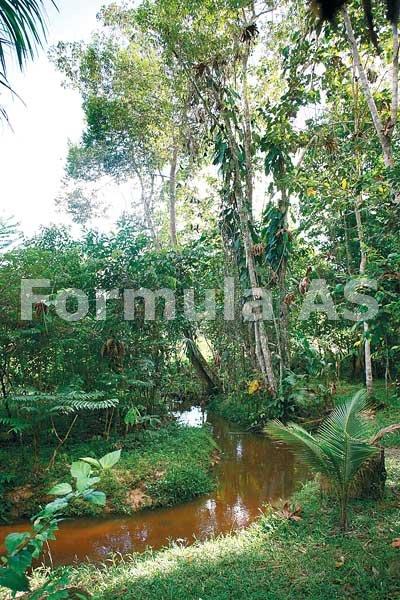
Jungla peruana

- O calatorie in adancurile inimii -

Amazonia

Am presimtit dintotdeauna aceasta clipa in care voi fi aici, in care voi trage in piept aerul umed si fierbinte al Amazoniei, in care voi zgaria cu privirile globul de sticla albastra al cerului arcuit peste fluviu si peste junglele fara sfarsit care se intind de jur imprejur pana la orizont. Aceasta presimtire tacuta a stat ingropata in adancurile mele, pana in aceasta clipa solara, cand, imbarcat pe un fel de barca lunga de vreo zece metri, care abia se misca, strabat meandrele fluviului Ucayali. Este enorm. Uneori, malurile acoperite cu padure virgina se indeparteaza atat de mult, incat nu se mai pot vedea.

Atunci cand se apropie, pot simti respiratia de un verde adanc a acestui ocean vegetal unic pe planeta, a acestei fiinte inimaginabile pentru mintea unui european, ii pot simti greutatea umeda cu care apasa malurile si ii pot auzi murmurul. Ieri am vazut-o din avion, intinsa pana la orizont. Soarele apunea in padure ca si cum s-ar fi scufundat intr-o mare nemaivazuta si am vazut sarpele imens de apa al acestui fluviu facand mii de meandre rotunde, ca si cum ar fi incolacit pamantul intreg.

Selva Grande, asa ii spun peruanii acestei regiuni, adica Padurea cea Mare. Este intinsa cat o jumatate de continent si mai are inca misterele ei, spatiile ei neatinse inca de civilizatie. Si iata-ma pe mine, cel care a visat-o, strabatand-o odata cu apele namoloase ale marelui fluviu. Caldura este coplesitoare, soarele arde infernal. Ce caut eu aici, la 15 mii de kilometri de casa, in adancurile celor mai salbatice paduri de pe continentul sud-american?

Ucayali pare furios, suvoaie enorme de apa se rotesc in ochiuri maronii, caci este sezonul marilor inundatii, salupa noastra din lemn putred, supraincarcata, cu motorul gafaind, pare o jucarie in mijlocul talazurilor. Il privesc pe Rodrigo, nativul care manevreaza salupa, cu o figura impasibila. Am certitudinea, in aceasta clipa de vant care-mi arde fata, in mijlocul apelor acestui fluviu si in mijlocul acestei nesfarsite paduri, ca toata viata am asteptat intr-un fel sa ajung aici. Sunt deja de doua saptamani in Peru, si daca la inceput, motivele pentru care venisem imi erau clare, acum incepeam sa banuiesc ca dincolo de acestea mai exista ceva. Adevaratul motiv pentru care eram aici.
Peru - taramul fiintelor nevazute

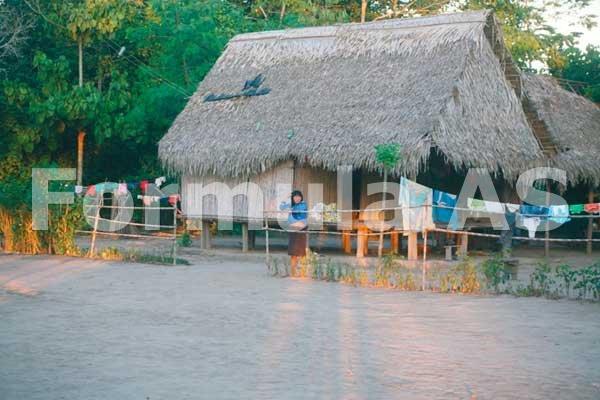
Gospodarie din sat

Acum doua saptamani, as fi enumerat o lunga lista de motive pentru a fi in adancurile junglei amazoniene: aventura in sine, faimosii curanderos sud-americani, acei vraci extraordinari care stapanesc secretele vietii si ale mortii cu ajutorul plantelor de leac, ayahuasca, planta magica ce te face sa calatoresti in adancurile si in inalturile propriei constiinte...

Acum, in aceasta clipa extraordinara de pe fluviul Ucayali, in arsita soarelui, calarind valtorile adanci in aceasta coaja de nuca, imi dau seama ca de fapt adevaratul motiv al prezentei mele aici tine in mod straniu de inima mea, spatiul misterios si atemporal care a stiut dintotdeauna ca intr-o buna zi voi face aceasta calatorie. Ca strafulgerarea unei pasari pe cer imi trece prin cap ca, intr-un fel, orice calatorie este interioara. Departarea te face sa privesti interior si sa vezi acolo ceea ce acasa n-ai putut vedea.

Peru - taramul fiintelor nevazute

Asteptand oaspeti

Ma indrept spre un sat care se numeste Santa Rosa de Dinamarca. E un nume ciudat pentru o asezare din Amazonia peruana. Dinamarca, adica... Danemarca, in memoria unor calugari danezi care, cu numai 50 de ani in urma, au debarcat in umbra "pagana" a padurii reusind sa fondeze o parohie, incercand sa crestineze unele dintre ultimele triburi shipibos, "salbatice".

Dupa 400 de ani de evanghelizare cu sabia in mana, facuta de spanioli si de altii, dupa mii de tone de aur furate si cateva stralucitoare civilizatii native distruse, Europa isi trimitea ultimii emisari sa aduca lumina crestina in adancurile padurilor nepatrunse.
Jungla aceasta adanca si fluviul reprezinta casa ultimilor descendenti ai faimosilor Panos, o civilizatie straveche, care traia pe continent cu 4500 de ani in urma. O civilizatie a carei arta si spiritualitate uimeste si in zilele noastre.

Triburile Shipibo, Amaguaca, Capanahua, Cashibo, Mayoruna, Pisabo, Yaminahua si altele sunt ultimele ramasite spulberate ale acestei civilizatii. Traiesc in mileniul trei, ca acum mii de ani.
Civilizatia occidentala nu a reusit sa distruga complet acea cunoastere ancestrala care i-a insotit de-a lungul istoriei. Isi pastreaza inca traditiile stravechi, vracii lor, celebrii curanderos, mai stiu sa faca ceremonii la fel ca acum mii de ani, cu plantele lor magice. Vreau sa vad toate astea cu ochii mei. Un miracol al supravietuirii, o oaza al carei timp curge altfel decat in restul lumii.


Santa Rosa de Dinamarca

Marea salupa putreda intra in cele din urma pe un canal stramt, traverseaza lagune bizare, nori de tantari si bancuri de pesti ciudati care sar din apa la trecerea ei, pentru ca in cele din urma sa ajunga in fata unui mal inalt. O streasina de copaci inalti de 10 metri face umbra. Iar in umbra aceasta, stau vreo suta de oameni tacuti, privindu-ne. Nu se aud decat sunete de pasari necunoscute.
Peru - taramul fiintelor nevazute

Pe laguna sacra

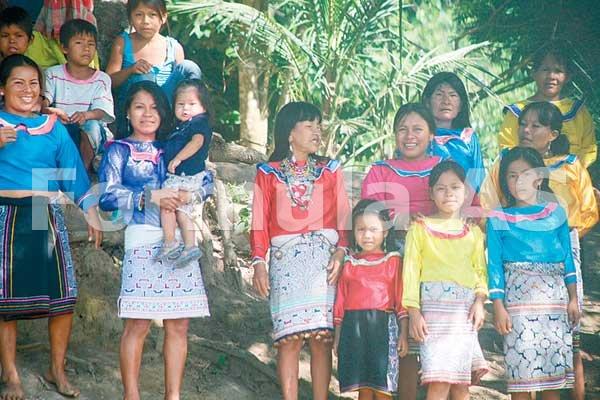
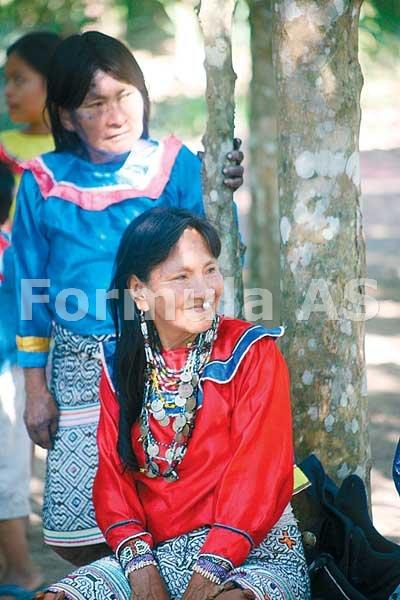
E un tablou uluitor. Sunt imbracati in hainele lor de sarbatoare, colorate cum n-am mai vazut niciodata, in toate culorile curcubeului, cu modele geometrice stranii. Sunt mici de statura, cu pielea intunecata, cu copii in brate, pete stranii de lumina solara danseaza pe chipurile lor impenetrabile. Nici un gest. Nici o vorba. Doar privesc. Chiar si copiii sunt tacuti.

Barca se apropie cu motorul oprit si acosteaza. Sunt ca niste statui in miniatura. Au ochii oblici. In clipa in care primul dintre noi pune piciorul pe malul fluviului, satul explodeaza. Bubuituri de tobe ritmice, chiote, rasete, clopotei, voci de femei si de barbati laolalta canta o muzica alerta, in limba lor. Ei sunt Shipibos! Rad cu gurile pana la urechi. Se dovedeste ca au pregatit o primire triumfala, pentru cei cativa europeni care venim la ei.

Ne iau de maini si ne conduc in umbra padurii, printre colibe de lemn acoperite cu impletituri de palmieri, pana intr-un loc ce pare a fi locul unei adunari. Bancute minuscule de lemn inconjoara locul acesta in forma de patrat.
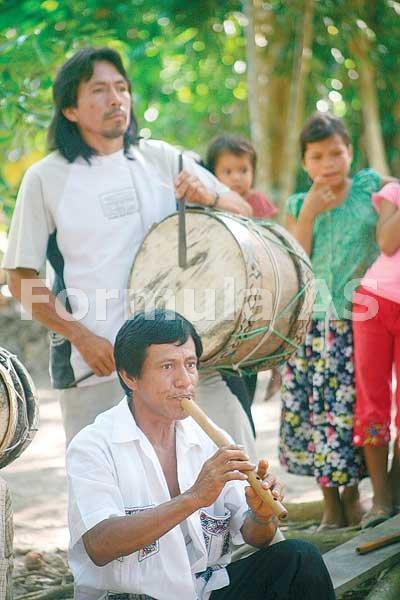
Barbatii satului sunt imbracati in camasi albe, cu modele colorate, au tobe si fluiere, praful se ridica spre bolta inalta a copacilor caci, in cele din urma, tot satul danseaza in picioarele goale, in cercuri concentrice, intr-o uriasa serpentina la care participa toata lumea, inclusiv noi.

In cele din urma, vacarmul se potoleste si toata lumea priveste catre un barbat marunt, stirb, care lasa din mana tamburul si fluierul si tine un mic discurs in limba spaniola.
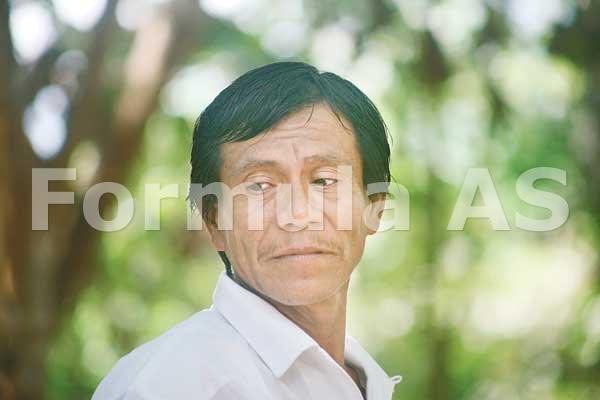
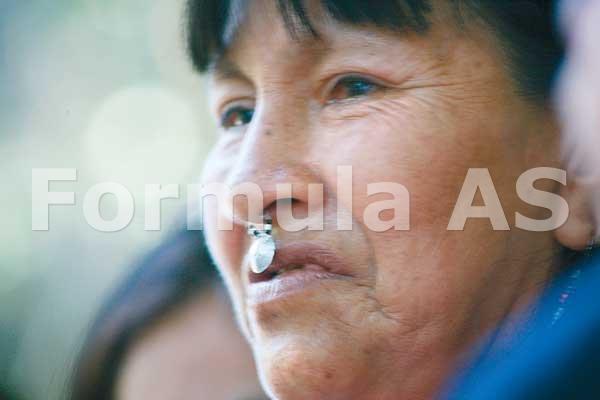
E semnul unui om educat, caci cea mai mare parte dintre ei nu vorbesc decat shipibo, o limba care seamana cu ciripitul de pasari. Barbatul se numeste Diogenes Garcia si este liderul acestei mici comunitati. In dreapta sa se afla Elias Fernandez, cumnatul si ajutorul sau, iar in dreapta, o femeiuta micuta, gatita de sarbatoare, purtand in nas o bijuterie bizara, pe care o prezinta drept sotia sa, Anita. Ne ureaza bun sosit in casa lui. Padurea are trei etaje deasupra, iar cerul nu se zareste.
Peru - taramul fiintelor nevazute

Cantecul pentru Grande Madre

Lumina are culoarea mierii verzi. Am auzit despre omul acesta cu mult inainte sa ajung aici. Are faima unui mare vindecator, cunoscator al plantelor de leac. Am auzit ca poate vorbi cu spiritele plantelor si ca, uneori, poate vedea prin oameni, asa cum s-ar uita cineva la o radiografie.
Sunt uimit, pentru ca nimic din aparenta sa de om mititel al padurii nu se potriveste cu aceasta faima. Oamenii acestia sunt de o saracie cumplita, cele mai bune haine ale lor, acestea de sarbatoare, sunt modeste si prafuite.

Diogenes are mainile muncite ca un adevarat taran, si calcaiele crapate. Intr-un fel, pentru el am venit aici, pentru el am strabatut jumatate din globul pamantesc, venind dintr-o tara necunoscuta, pe nume Romania, astfel ca il privesc cu toata atentia. Poarta pe fata urmele vietii si ale saraciei, cu o anumita voiosie. Vorbeste despre plante si despre spiritele padurii, despre anaconda si despre duhurile unui univers nevazut.

Spune ca fiecare planta a padurii a fost lasata de Dumnezeu pentru ceva, pentru o nevoie a omului, ca exista plante invatator si plante medic, plante pentru trup si pentru spirit, pentru inima fizica si pentru inima aceea nevazuta, ca un vartej luminos, pe care fiecare o poarta cu el, exista plante care vindeca tristetea si altele care vindeca ochii, si ca el ne poate arata unele lucruri. Atunci cand vorbeste el, femeile, copiii si pasarile tac, desi nici un fel de autoritate nu pare sa razbata din vorbele lui. Dimpotriva, o blandete stranie, moale, in felul in care articuleaza spaniola pocita.


Stapanul spiritelor

Zilele care au urmat tin mai curand de domeniul visului decat de realitate. In timp liniar, am stat in Santa Rosa cinci zile. Dar ar fi putut fi cinci secole. Timpul este acolo rarefiat si dens in acelasi timp. Am locuit in colibe din lemn, suspendate la jumatate de metru deasupra pamantului, am dormit pe saltelute acoperite cu plase de tantari.
Peru - taramul fiintelor nevazute

Fiertura magica

Dusurile erau niste ingradituri din lemn in care turnam apa cu ibricul, inainte de a ne usca la lumina stelelor si a lunii care se roteau pe cer in spirale. Zilele incepeau la rasaritul soarelui, si noptile incepeau odata cu apusul, caci oamenii de la Santa Rosa pulseaza odata cu ritmurile padurii.

In mijlocul satului se afla o baraca din lemn, circulara. Maloka. Spatiul sacru. Era locul de intalnire la ceasul de taina al noptii, cercul sacru in care Diogenes, insotit de Anita, sotia lui, si de Elias deveneau altcineva. Plantele sacre si cantecele lor venite din lumi paralele mi-au dezvaluit o lume uluitoare si dimensiuni ale constiintei care mi-au schimbat pentru totdeauna felul de a-i privi pe acesti oameni, pe mine insumi si universul din care facem parte cu totii.

Istoria acestor calatorii interioare nu poate face obiectul unui reportaj, dar ceea ce va pot spune este ca oamenii acestia traiesc in alte dimensiuni decat noi, europenii, iar motivul pentru care pomenesc aici despre aceste incursiuni in lumile nevazute este acela ca shipibos si altii asemenea lor nu pot fi intelesi in afara acestor calatorii.
Ei traiesc in mijlocul padurilor lor intr-o realitate extinsa, ei pot vedea spiritele, energiile plantelor si animalelor, pot atinge structura imateriala, nevazuta a Universului, si stiu sa se foloseasca de ea in scopuri foarte precise.
Peru - taramul fiintelor nevazute

Maestro

Pentru ei, padurea nu este o adunatura de copaci mari, tocmai buni de pus pe foc, ci este o fiinta complexa, de o maretie si o lumina inimaginabile pentru noi, pentru ca ei o vad cu ochii lor in acest fel.
Diogenes se transforma in timpul noptii, pur si simplu, intr-o fiinta extraordinara, intr-un magician uluitor, care putea vorbi cu plantele in asa fel, incat aducea vindecarea in trupurile si in spiritele oamenilor. Pentru mine a existat in permanenta o adevarata ruptura intre vraciul fabulos al noptii, si omul de o simplitate, de o bunatate si de o modestie extraordinare, din timpul zilelor.

Dar pentru acest om, caruia membrii comunitatii i se adresau cu "Maestro", nu exista aceasta separare. Lumea spiritelor in care putea comunica cu plantele de leac si in care putea vedea prin oameni ca printr-o sticla nu se termina odata cu noaptea. si nici pentru ceilalti shipibos. Pentru ei, prezenta Divinitatii in orice piatra, in orice planta, in orice animal, in pamant si in luna si in soare este un lucru evident.

Ei folosesc duhurile plantelor in cele mai practice moduri, asa cum noi ne folosim de un cal la caruta. Am avut mii de intrebari pentru Maestro si pentru ceilalti membri ai acestei comunitati minuscule de la capatul lumii, pe masura curiozitatii mele nemasurate.
Pe masura ce imaginea mea despre aceasta lume s-a conturat, am inteles ca oamenii acestia sunt intr-un fel aidoma stramosilor nostri, cunoasterea lor este o cunoastere ancestrala, proprie intregii umanitati, numai ca noi, pur si simplu, intr-un moment al istoriei, am luat-o pe un alt drum. Razna!


Cele ce urmeaza nu sunt povestea unei zile si nici nu respecta o anumita cronologie. Sunt impresii, momente si picaturi din acele zile fara timp, pe care le-am petrecut in Santa Rosa de Dinamarca. Ghidul meu a fost Diogenes, Maestro, stapanul spiritelor nesfarsitelor paduri de pe Ucayali.

Grande Madre

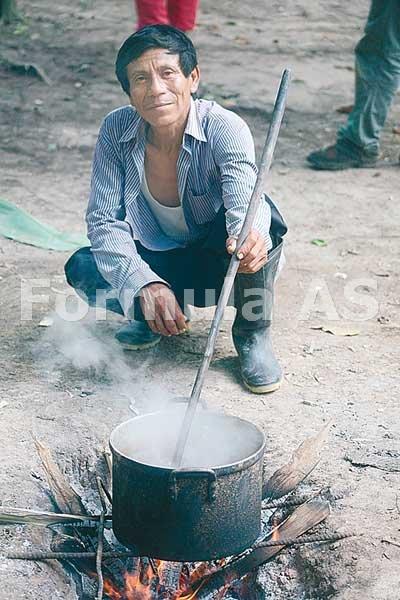
Maestro sta pe vine, aplecat asupra unui ceaun, nu prea mare, pus pe foc, in care amesteca lent, cu o rabdare soptita. E dimineata devreme, nici o pala de vant, soarele arde undeva, deasupra triplului plafon de frunze al junglei, copaci care seamana mai mult cu niste animale inflorate urca in cer in spirale, odata cu fumul.
Peru - taramul fiintelor nevazute

Anita, sotia Maestrului

Sunt 40 de grade. Nu scot o vorba, doar privesc. Pasarile zilei coloreaza arsita cu ghirlandele a milioane de voci, omul sta aplecat deasupra ceaunului si fluieratul sau se ridica din ceaun, amestecandu-se cu al pasarilor. Ochii sai sunt numai acolo, in fiertura maronie.
Apoi fluieratul se transforma intr-un firicel de voce, care apoi se transforma intr-un cantec subtirel. Si cantecul prinde puteri, se ingroasa, prinde substanta, se inalta, se roteste, pentru ca in cele din urma sa se prabuseasca din nou, in jar.

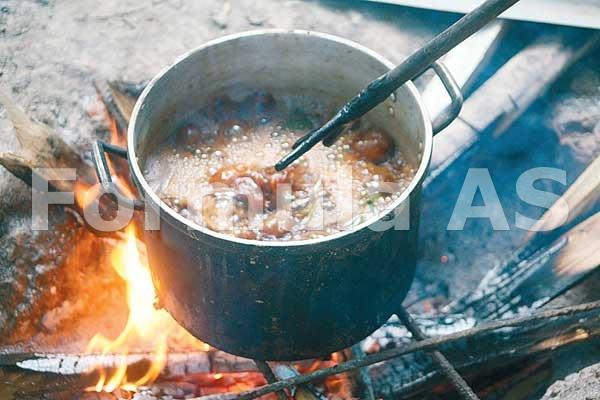
Maestro canta pentru ayahuasca, pentru Grande Madre, mama tuturor plantelor, puntea cea mare catre lumea spiritelor, iar cantecul lui este o ofranda, si mai mult decat atat, este un fel de funie de sunet pe care spiritul plantei se catara din fiertura, catre lumea reala. Maestro o cheama, o roaga cu cel mai mare respect sa vina, sa se manifeste, o asigura ca oamenii au nevoie de ea, de sfaturile ei, de viziunile ei, iar spiritul plantei se ridica in fuioare incolacite deasupra ceaunului.

Zece kg din trupul de lemn al acestei liane colosale, ayahuasca, sunt fierte pentru a obtine fiertura magica, peste care se mai adauga o planta pe nume chakruna, caci aceste doua plante sunt ca soarele si luna, ca fluviul si malurile sale, ca inima si bataile sale, nu se poate una fara alta, si amandoua sunt nimic fara cantecul maestrului.

Nu oricine poate face asta. Duhul plantei nu asculta decat de unii oameni, iar descantecul soptit de Diogenes are o putere uriasa, pentru ca este vechi de cand lumea. "Prima data a fost cantat de primul om". Cu fiecare cantare a prins puteri, iar in mii de ani, descantecul acesta a dobandit o putere atat de uriasa, incat putini oameni au curajul sa-l foloseasca, daramite sa se mai si joace cu el, asa cum face Diogenes.

El este un artist, un poet, stie ca Mamei tuturor plantelor ii place uneori sa se joace, astfel ca el adauga tot felul de jocuri in descantec, ca sa-i faca placere.

"Doamna Mare, Doamna Mare, nu te chemam pentru necaz, ci pentru bucurie, nu te chemam pentru boala, ci pentru vindecare, nu pentru moarte, ci pentru viata, nu pentru intuneric, ci pentru lumina...",
cam asa e cantecul lui Diogenes, intr-o traducere aproximativa, si asta ma face ca aici, in mijlocul junglei amazoniene, sa ma intreb prin ce mister acest cantec/descantec sa semene atat de mult cu invocatiile pe care le-am auzit in Maramuresul nostru, de la o femeie care obisnuia sa insoteasca cu el dezgroparea plina de respect a unei radacini de matraguna, ce urma sa fie folosita pentru lecuirea unei iubiri nefericite.

Peru - taramul fiintelor nevazute

Oarba Eleonora

Aveam sa umblu mai tarziu pe cararile junglei, impreuna cu Maestro, si el avea sa-mi explice cu naturalete cum aceasta planta incredibila deschide portile comunicarii cu orice alta planta si cu orice alta fiinta vie din univers, fie ea o fiinta materiala sau inefabila. Este suficient sa rostesti ceea ce doresti si puntile se deschid.

El, Diogenes, pleaca uneori in jungla cate-o luna intreaga, singur, mananca numai radacini si bea apa numai din laguna spiritelor, pe care mi-o va arata si mie daca vreau, si in noptile singuratatii sale bea fiertura de ayahuasca si ea ii arata secretele vietii si ale mortii, tainele trupului omenesc si ale mintii, cheama pentru el spiritele din alte lumi, atunci cand el are nevoie de ajutor. Orice... spirit? intreb.

Maestro ma priveste o clipa, ca si cum mi-ar fi ghicit gandul nerostit. Da, uneori poate vedea... sfintii crestini, pe San Juan sau San Paulo sau pe Santa Maria de Luz, care sunt fiinte de lumina, dar asta rar, pentru ca oamenii vin la el abia atunci cand umbra inimii a cazut deja in trup si ei sunt bolnavi, si atunci au grabnic nevoie de duhurile unei plante. Bine, dar ce vede, ce face acolo, in lumea luminoasa "de dincolo"? Cum ce face?

Mai intai vede, si apoi canta cu vocile plantelor de leac, iar cantecul curata raul din corp, din inima si din spirit, cu puterea plantei respective, iar raul se scurge in pamant, la Pachamama, Mama Pamant. Fiecare planta de leac are vocea ei si cantecul ei, sunetul ei, el le poate auzi pe toate, dar nu le cunoaste chiar pe toate, dar atunci cand nu stie ce sa faca, atunci Grande Madre ii arata care planta e buna.

Iar daca nu stie cantecul acelei plante, nu face decat sa asculte cu atentie si sa-l invete. Uneori, se duce noaptea in padure, gaseste planta dupa lumina ei, asa cum i-a aratat-o Grande Madre, caci fiecare planta, fiecare frunza, are lumina ei, culorile ei, duhul ei, si-i canta ce-a invatat, inainte de a o lua pentru leac.


Femeile padurii

Peru - taramul fiintelor nevazute

Kuinti-Aka si sangele copacului

Lumina padurii ecuatoriale in timpul unei nopti este indescriptibila. Este un intuneric luminos, caci exista plante care au darul sa te faca sa vezi in intuneric. Sevele universale, care sunt luminoase, devin vizibile in toti copacii si se amesteca tulburator cu lumina stelelor rotitoare si a licuricilor uriasi ai padurii. Tot indescriptibil este cantecul subtire al unei femei, strecurandu-se ca un sarpe inaripat si transparent prin acest intuneric luminos.

Am auzit un asemenea cantec, intr-una dintre noptile magice de pe Ucayali. A doua zi am aflat ca stapana vocii era o femeie din sat, care canta de cateva zile unui copac. Un copac, desigur, fermecat.
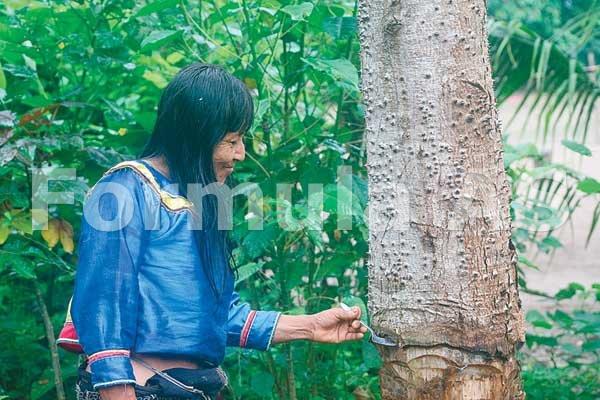
Am cautat copacul undeva, acolo unde ultimele colibe ale satului se pierd in jungla, si l-am gasit. Femeia era acolo. Cand am ajuns, statea nemiscata langa marele arbore, imbracata intr-o camasa albastra, de sarbatoare, si avand o fusta de ceremonie, asa cum se cade atunci cand te duci in vizita la un personaj important.
Purta in mana dreapta o maceta, un fel de sabie scurta, pe care localnicii o folosesc ca sa-si croiasca drum prin hatisurile junglei. Statea incremenita langa copac.

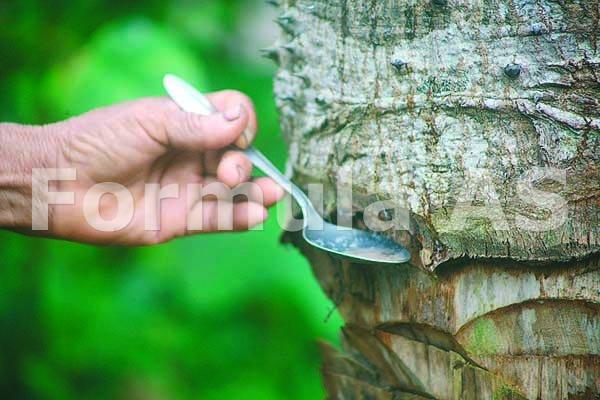
Ma apropii si vad ca in mana stanga are o lingura in care se scurge sangele copacului, rosu, gros, dintr-o crestatura pe care ea a facut-o in coaja lui. Nu ma priveste, nu ma poate privi, atenta la ceea ce face, caci fiecare picatura este pretioasa. Cand lingura se umple, ea o varsa intr-o cutiuta pe care o tine agatata la brau. Copacul este plin de crestaturi, iar ea, in zilele de cand sta aici, a inceput sa capete ceva din imobilitatea lui.
Peru - taramul fiintelor nevazute
Maestro e cu mine, caci ea nu vorbeste decat limba pasarilor si a copacilor cu sange omenesc. O cheama Kuinti-Aka. Kuinti inseamna Inima. Aka inseamna femeie. Are o varsta incerta.
Inainte de a sti la ce foloseste sangele copacului, as vrea sa stiu despre sarpele transparent al cantecului pe care l-am auzit in noaptea luminoasa, incolacindu-se pe crengile arborilor.

Imi spune ca arborele ei are nevoie de tamaduire, ca ranile pe care ea i le face cu maceta il dor, ea stie asta, simte asta, si pentru ca are totusi nevoie de sevele lui, si pentru ca el sa sufere mai putin, ramane noaptea si-i canta cantecul vindecarii si-i oblojeste ranile, si vorbeste cu el, ii povesteste cat de multe lucruri depind de seva lui fermecata, de care are nevoie nu numai ea, ci toate femeile din sat. Seva cea rosie ca sangele, amestecata cu apa si descantata, se va transforma intr-o licoare de culoare intunecata, pe care femeile si-o pun in ochi pentru a vedea... nevazutul.


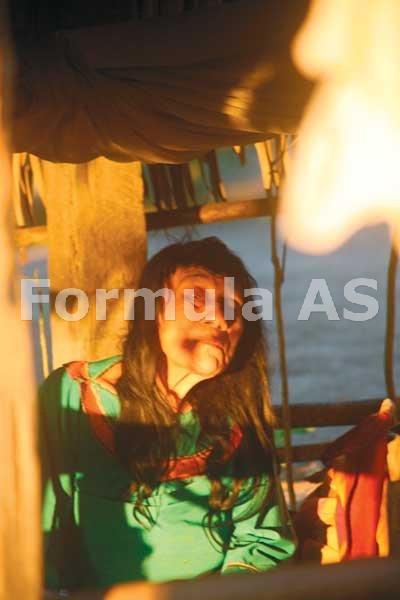
Asa aveam sa aflu despre unul dintre cele mai extraordinare daruri ale padurii. Aceasta licoare care se pune regulat, o data pe luna, in ochii tuturor femeilor, fetelor si fetitelor satului, inclusiv bebeluselor de cateva luni, are darul de a le face, pur si simplu, sa vada lumea altfel.
Toate cusaturile lor extraordinare, haine, camasi, cuverturi, toate picturile ceramicii lor, incrustarile in lemn, toate decoratiunile pe care aceste femei le fac sunt desenele si culorile pe care ele le vad si pe care le copiaza. Nimic nu este inventat.

Totul este vazut si copiat cu cea mai mare atentie. Licoarea magica a copacului este esentiala, pentru ca o mare parte din banutii comunitatii vin din comertul cu aceste cusaturi artizanale, pe care o salupa le colecteaza periodic, le duce in marile orase, si de-aici se exporta ca obiecte de arta shipibo, si pot fi gasite in galeriile occidentale, la preturi exorbitante. Aici insa, un obiect la care s-a muncit o saptamana sau doua costa cativa dolari.

Peru - taramul fiintelor nevazute

Traditii neschimbate de mii de ani

Aveam sa vad femeile padurii adunandu-se in mijlocul satului, cu copii, cu cusaturile lor, aveam sa vad fetite de 8 ani lucrand la tapiseriile lor uluitoare si aveam sa inteleg dimensiunea miracolului.
Aceste femei care privesc in lumea invizibila sunt pastratoarele unei traditii enorm de vechi. Obiectele pe care le fac ele acum, in secolul 21, sunt asemanatoare cu cele ale unor culturi stravechi si celebre, cum este Ashaninka, dupa care se dau in vant colectionari din toata lumea. Doar ca ele habar n-au de Ashaninka.

Singurele lor uimiri sunt in legatura cu oamenii albi, care doar acum 50 de ani le-au scos pe mamele lor din paduri si le-au obligat sa mearga la biserica, sa-si arunce portul stravechi si sa uite de spiritele plantelor, iar acum, dupa numai o generatie, acelasi om alb se intoarce cautand vindecare in lumea spiritelor padurii si scormonind dupa vechea lor lege.


Omul alb care sunt si-a dat seama ca, de fapt, nu a existat decat o singura lege candva, pretutindeni, care s-a pierdut si care este pe cale sa fie redescoperita. Spiralele lor solare, modelele varstate inchipuind sarpele sacru al vietii, crucile innodate in cercuri magice si multe alte lucruri pe care le-am vazut acolo le-am recunoscut. Sunt izbitor de asemanatoare cu cele mai vechi modele populare romanesti, pot fi vazute pe iile si pe fotele din Carpati.

Vi se pare ciudat? Atunci sa va spun ca le-am vazut si in India, si in alte parti din lumea intreaga, pe vasele de Cucuteni sau Gumelnita, vechi de mii de ani, ca si pe vasele Mochika. Nu e nici un mister, ci o evidenta.
Traditiile stravechi care au supravietuit aici, in jungla amazoniana, au fost vii pretutindeni, aceasta cunoastere, aceasta simtire a spiritului naturii, aceasta apropiere formidabila de sufletul universului a traversat epocile. Numai ca in Europa oamenii au uitat ca pot privi in adancurile firii, picurandu-si sange de copac in ochi.


Anaconda

Soarele apune in fluviu, apele fierb, pasarile zilei se dizolva in cer, iar cele ale noptii se nasc din frunzisurile adanci. Mirosurile grele ale pamantului umed de secole se tarasc pe pamant ca serpii. Stau pe malul fluviului, sub copaci napaditi de flori mov. Asfintitul e singurul moment al zilei in care lumina soarelui spulbera umbra junglei.

Sunt asezat pe pamant, privind apele adanci. Ma gandesc la Anaconda, sarpele urias care traieste in Laguna Sacra si care iese uneori pentru a intra in fluviu, provocand valuri uriase si vartejuri care distrug barci, plute si oameni. Dar inainte de orice, Anaconda este un spirit foarte puternic, foarte batran si foarte respectat, care poate fi invocat, vazut, rugat sa te ajute atunci cand ai nevoie de ceva foarte important.
Peru - taramul fiintelor nevazute

In Santa Rosa, doar doi oameni pot vedea Anaconda. Unul este Maestro, care o poate vedea si vorbi cu ea. Darul de a vedea Anaconda se mosteneste. si iata-ma vopsit in culorile de aur ale apusului, asezat pe pamant, pe malul fluviului, privind-o pe aceasta femeie oarba pe nume Eleonora, mama vraciului Diogenes, foarte batrana, care locuieste intre patru pereti din bete, in lumea ei. E foarte respectata, desi nu vede si nu aude nimic.

Nu pot vorbi cu ea. O pot doar privi. Doar asculta. Se spune ca Anaconda e cu ea tot timpul, ca traieste aproape permanent in lumea spiritelor. Canta incetisor. stie ca sunt aici si ca o privesc.

Un foc mic din vreascuri e aprins pe nisip. Firele subtiri de fum portocaliu se rotesc in jurul ei in lumina apusului ca si cum ar dansa. Ea deseneaza forme pe nisip cu degetele noduroase si as putea sa jur ca fumul ia formele rotunde ale desenelor ei. Nu face nimic. Doar vorbeste cu spiritele. Femeia aceasta s-a nascut in jungla. Este unul dintre putinii supravietuitori care i-au vazut pe calugarii danezi fondand acest sat. Numele de Garcia i-a fost dat mai tarziu. Numele ei adevarat este Yoda-Moa-Aka. Yoda inseamna corp. Moa - frumos. Aka - femeie.

Dintr-o data, ea ridica din fum ochii orbi catre mine si ma priveste o clipa care dureaza o suta de ani. Timpul se opreste in loc, soarele e suspendat deasupra apelor, fumul portocaliu incremeneste in aer, sunetul pasarilor asfintitului intepeneste in tacere. O fulgerare ascutita imi strapunge inima. Apoi fumul a reinceput sa danseze, soarele sa se reflecte in el ca in pielea unui sarpe si femeia a reinceput sa cante pentru el.

Din spatele meu se aude vocea lui Diogenes, care-mi spune doar atat, ca am avut privilegiul de a o vedea pe mama lui vorbind cu Anaconda. Yoda-Moa-Aka, zisa si Eleonora Garcia, a chemat duhul Anacondei pentru a-l intreba daca Diogenes poate duce strainii, adica pe noi, la Laguna sacra.


A doua zi aveam sa strabatem o bucata de drum cu barca pe fluviu, apoi pe jos niste smarcuri, niste mlastini cumplite, nori de tantari si de insecte nebune care ni se prindeau in par si de haine, printre serpi si zgomotele nemaiauzite ale unor carari pe care numai Diogenes le vedea.

Elias, cumnatul sau, deschidea drumul prin hatisuri cu maceta, rostind descantece in aerul greu. Laguna era asa cum mi-o imaginasem. Un lac perfect curat, perfect calm, acoperit cu un glob de liniste care-ti dadea tiuituri in urechi. Nici o pasare. Un nor statea suspendat in cerul senin deasupra ei. Nici o unduire. Dintre ierburi, Maestro a scos o piroga scobita in trunchi de copac, straveche, lipita cu pamant ca sa nu se scufunde.

M-am imbarcat impreuna cu el pentru o plimbare prin curtea de apa a Anacondei. Maestro si Elias vorbeau in soapta. Orice cuvant se reverbera pe suprafata de sticla a Lagunei sacre, lovindu-se de cer. Orice soapta derapeaza pe linistea absoluta. Racoarea este a unui vant care a uitat sa bata. Iti poti auzi inima, ca si cum lacul si cerul nu ar fi decat o cutie de rezonanta. Vocile interioare tac.


Maestro ma atinge usor cu mana pe umar. Imi spune in soapta sa-mi dau cu apa pe cap. Spala gandurile. Apoi ma intreaba daca, cu o zi inainte, mama lui, batrana Yoda, m-a privit cumva in ochi. Dau din cap, iar el zambeste larg. Anaconda este aici. In noaptea care a urmat am vazut-o. Dar asta este o alta poveste.

Concluziile inimii

Zilele pe care le-am petrecut in satul shipibo au fost ca o scufundare in istoria umanitatii, caci, intr-un fel, oamenii acestia traiesc la fel ca in epoca de piatra. Credeam ca saracia lor si indepartarea de civilizatie, asa cum o cunoastem noi, ii face nefericiti.
Peru - taramul fiintelor nevazute

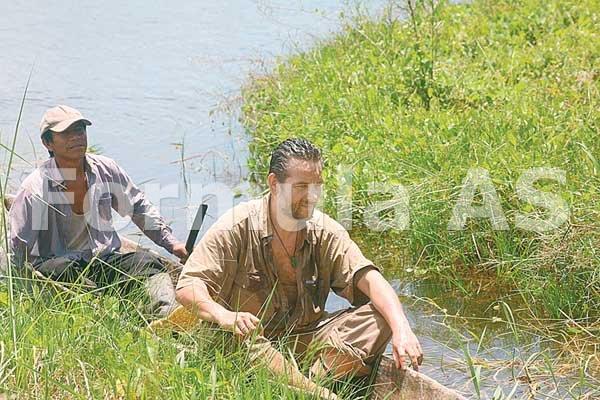
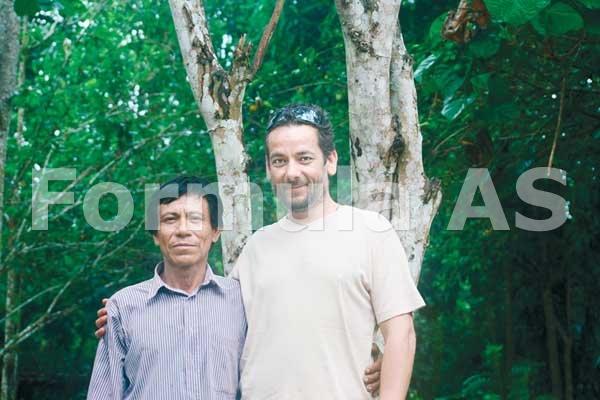
Maestro si reporterul

Apoi am observat ca noi, cei veniti din lumea civilizata, eram cei incruntati, cei bantuiti de umbre, noi eram cei care cautau vindecarea de ganduri. Shipibos sunt un popor zambitor.
Surasul larg este pentru ei un mod de a trai. M-am intrebat cine sunt de fapt cei nefericiti, cei rupti de adevarata lor fiinta si de univers, cine sunt cei neimpacati, cei care cauta la capatul lumii adevarul interior care le scapa printre degete? V

enim din lumea noastra cu tehnologii avansate, stresati, bantuiti de mii de intrebari fara raspuns, si primul impuls este acela de a-i compatimi, de a-i ajuta cumva sa iasa din saracie, iar ei surad. Orasele noastre sunt stralucitoare de luminile limuzinelor si ale vitrinelor, lumea lor are insa stralucirea energiilor universului si a stelelor rotitoare.

Noi il cautam pe Dumnezeu in bisericile noastre si in carti, ei il traiesc in mod imediat, direct, in fiecare gest, caci pentru ei orice actiune in lumea fizica este sacra. Noi cautam in afara, uitand mereu ca sfintii nostri au trait revelatia inlauntrul lor. Pentru oamenii acestia, "afara" si "inlauntru" nu sunt decat concepte ale mintii. Inima lor bate in copaci.


Cand am plecat, fetele lor erau la fel de incremenite ca atunci cand veniseram. Doar ca la inceput, incremenirea fusese o gluma, iar acum era o adevarata parere de rau. De unde venea aceasta parere de rau? Pentru ei fuseseram niste extraterestri care se dovedisera umani. Pentru noi, ei fusesera niste curiozitati ale mileniului 21, iar acum ne intrebam daca ne vom mai revedea vreodata. Ei purtau tricourile noastre, iar noi camasile lor shipibo, cu modelele nevazute ale universului. Zilele si noptile petrecute impreuna au deschis niste punti. Puntile inimii.

Aceasta calatorie a existat dintotdeauna in interiorul meu. si pentru ca a existat, am trait-o. Sunt din nou pe Ucayali.

Fotografiile autorului

Related Posts Plugin for WordPress, Blogger...

Share

Twitter Delicious Facebook Digg Stumbleupon Favorites