Showing posts with label mistere. Show all posts

Monday, September 18, 2023

The Creepiest Thing Hidden In The Vatican!

Friday, October 7, 2022

Armata americană a făcut un experiment uimitor asupra ADN-ului uman. Iat...

Monday, September 5, 2022

Constantin Dulcan vorbește despre misiunea noastră pe Pământ și încotro ...

Thursday, November 29, 2018

Cum a început secretomania OZN

Cum a început secretomania OZN: Farfuriile zburatoare au fost văzute timp de mii de ani si multe apariții au fost consemnate în cronici sau înregistrate în picturile epocilor trecute

cybershamans (karmapolice) / CC BY-NC-ND 3.0


Share/Bookmark


Saturday, September 16, 2017

Dosarul de interdicție al lui Eminescu. Dezvăluiri. Vezi ce conține...


cybershamans (karmapolice) / CC BY-NC-ND 3.0
Share/Bookmark

Thursday, September 7, 2017

Locurile Sacre din România

Locurile Sacre din România


cybershamans (karmapolice) / CC BY-NC-ND 3.0
Share/Bookmark

Saturday, August 26, 2017

Adevărul despre Roswell

Adevărul despre Roswell - FilmeDocumentare.com


cybershamans (karmapolice) / CC BY-NC-ND 3.0
Share/Bookmark

Sunday, August 20, 2017

Construcții antice misterioase: Cine a construit Marele Zid din Siberia?

Construcții antice misterioase: Cine a construit Marele Zid din Siberia?


cybershamans (karmapolice) / CC BY-NC-ND 3.0
Share/Bookmark

Saturday, August 5, 2017

Minele regelui Solomon - Misterul ruinelor din Iordania

Minele regelui Solomon - Misterul ruinelor din Iordania


cybershamans (karmapolice) / CC BY-NC-ND 3.0
Share/Bookmark

Wednesday, February 8, 2017

MISTERUL CRANIILOR DE CRISTAL

Share/Bookmark

Saturday, April 16, 2016

Teleportation Alien Jinn Child Caught in Nepal CCTV


cybershamans (karmapolice) / CC BY-NC-ND 3.0
Share/Bookmark

Sunday, March 6, 2016

Pestera Polovragi, lacasul misterios al lui Zalmoxis. Triunghiul Bermudelor din Oltenia

Romania Megalitica: Comorile Romaniei. Enigme si mistere... la tot pasul! Pestera Polovragi, lacasul misterios al lui Zalmoxis. Triunghiul Bermudelor din Oltenia


cybershamans (karmapolice) / CC BY-NC-ND 3.0
Share/Bookmark

EXTRATERESTRII, intre speculatie si adevar. Urme extraterestre pe Pământ?!? Coincidente stranii, ori probe indubitabile?!?

Romania Megalitica: EXTRATERESTRII, intre speculatie si adevar. Urme extraterestre pe Pământ?!? Coincidente stranii, ori probe indubitabile?!?


cybershamans (karmapolice) / CC BY-NC-ND 3.0
Share/Bookmark

Friday, March 4, 2016

STRANGE UFO OVER BERLIN CAPTURED BY RUSSIAN SOLDIERS 1945


cybershamans (karmapolice) / CC BY-NC-ND 3.0
Share/Bookmark

Strange UFO filmed by Russian helicopter over West Siberia - Jan 2016 !!!


cybershamans (karmapolice) / CC BY-NC-ND 3.0
Share/Bookmark

Thursday, November 26, 2015

Versiunea șocantă a originilor piramidelor egiptene - „The Science”. Pyramids Egypt

Romania Megalitica: Versiunea șocantă a originilor piramidelor egiptene - „The Science”. Pyramids Egypt


cybershamans (karmapolice) / CC BY-NC-ND 3.0
Share/Bookmark

Wednesday, November 4, 2015

ARABIAN GENIES AND A FLYING MOSQUE


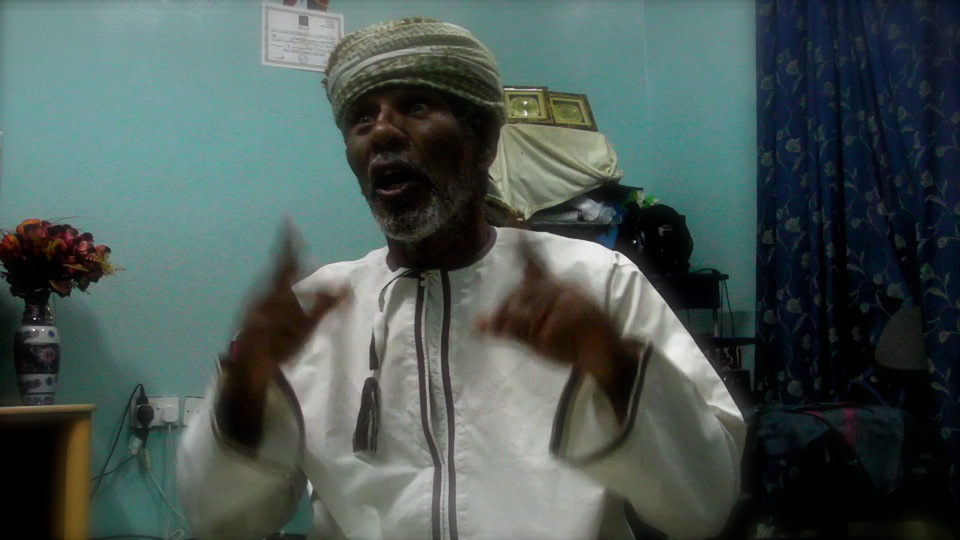
Moalim Salim (All photos by author)
Baxter Jackson takes us on a tour of a sacred Omani fort that is no longer open to the public, to discover the legends within.
WHEN I ASKED my Omani students from Bahla about the legends of genies and sorcery, they squirmed in their seats and very reluctantly shared with me the rumors about those who channel the power of the djinn (genies), the tale of a bewitched tree in the souq, and the legend of the flying mosque.
Living in Nizwa (38 kilometers to the south of Bahla) and loving the paranormal, these stories — of wizards controlling genies for their own nefarious purposes, of a tree more cursed than the Hope Diamond, and of a mosque that appeared miraculously overnight — piqued my curiosity.
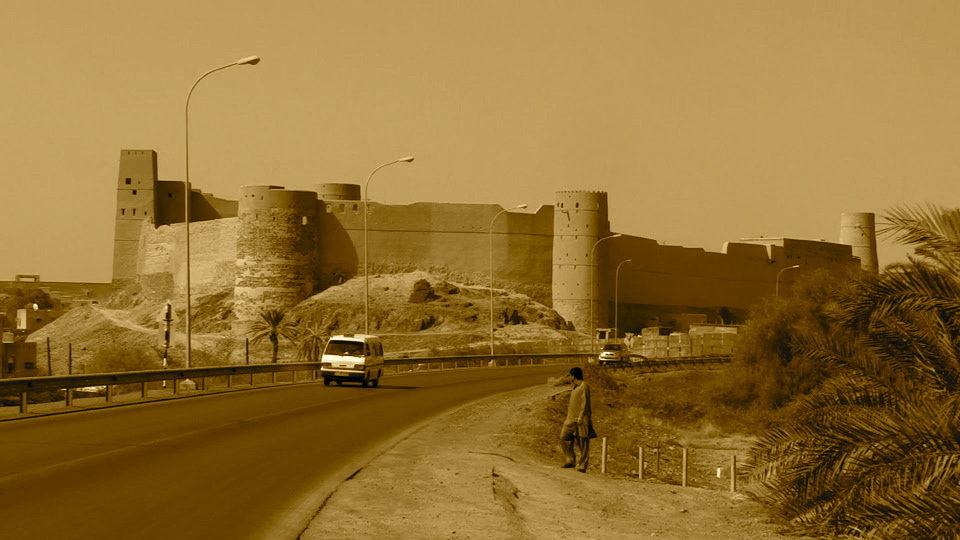
I needed to investigate firsthand. The only problem was that Bahla Fort, the epicenter of magic in the Sultanate, hasn’t been open to the public since it was declared a UNESCO World Heritage Site in 1988.
A colleague at the local college where I was teaching English just so happened to have a friend in the Omani Ministry of Culture who was willing to let us into the fort if we agreed to keep it hush-hush. A little bit more digging revealed that the man to talk to about such occult arts was Moalim Salim, a practitioner adept in dispelling djinn who had possessed the living.

Approaching Bahla Fort
In the shadow of the 17th century Jabrin Castle, Moalim Salim welcomed us into his villa (essentially a mini-castle complete with parapets). We removed our shoes at the door and were ushered into the majlis where we folded our legs under us and sat on the carpeted floor.
Over tiny cups of cardamon-laced Arabic coffee, he showed us his hajahs andhars, the amulets he uses to exorcise djinn. The first step in an exorcism, he explained, is to cross reference the alignment of the planets and stars at the time he is contacted with the birth sign of the afflicted.
Once that is established, and with the help of his sacred book of Al Ghazali, it’s all a matter of balancing the four elements of earth, wind, air, and fire. “When they’re out of balance on earth, natural disasters occur, and as it is on earth so it is with those Allah made of clay,” he explained.
Moalim Salim has been practicing what he refers to as ‘white magic’ since 1970, after a distinguished military career. He undertook his apprenticeship under the tutelage of Sheikh Said bin Abdulaziz Al Ta’abi, who learned his skill from the book of Al Ghazali, the great book of knowledge whose influence in Islamic thought is eclipsed only by the Prophet Mohammed himself.
The power of the djinn
Moalim Salim claims to have helped over 5,000 people all over the Persian Gulf. Masoud Al Shikely was one, a man from Bahla whose granddaughter fell under the spell of a jini and who had episodes of fits and blackouts (we shifted uneasily as he continued his story). For a period of ten days, Masoud’s family was under siege with spontaneous fires breaking out and nightly showers of stones during which his granddaughter would blackout and convulse.

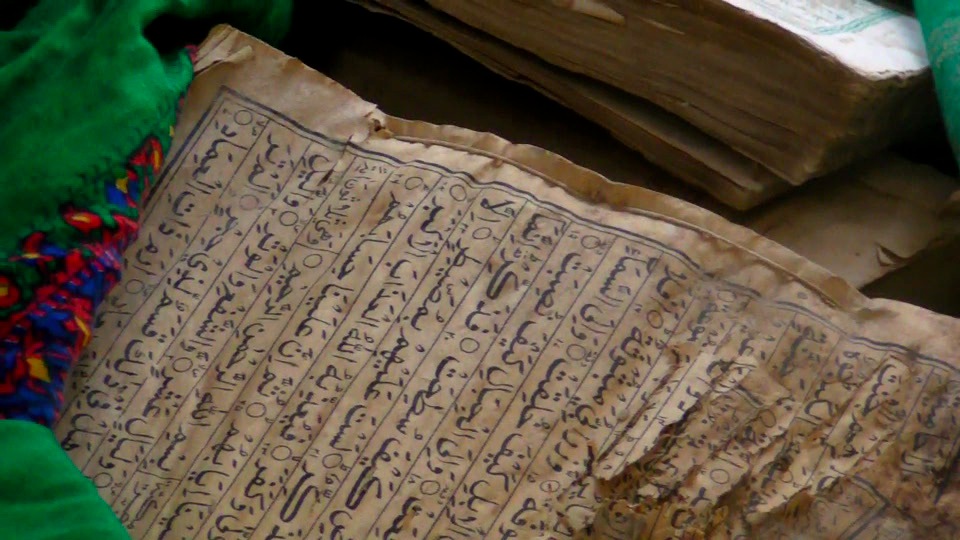
Old Quran at the Hill of Three Saints
When the burning of frankincense and the salt water baths didn’t work, an exorcism — guided by his own skillful hand and using the combined power of Quranic recitations along with the book of Al Ghazali — was finally able to free the little girl and the family from the djinn’s reign of terror.
We nodded in appreciation of the recounting, took one last sip of cardamom tea, and thanked him for his time. The next stop on our tour of the little village in the Omani hinterlands — the epicenter of all genies — was Bahla Fort.
A wizard haunting
Under the harsh rays of an Arabian sun, the iron door creaked as the gatekeeper opened it to let us into the deserted castle. From behind the milky whiteness of a cataract eye, he guided us to the area of the fortress where the djinn had been most wicked. All archeological attempts at restoration here had been repeatedly frustrated by an unseen force at night: stones erected and mortar plastered during the day would be found undone the next.
1400 years ago, a man was stoned to death by the villagers of Bahla for practicing wizardry.
Legend explains this phenomenon. 1400 years ago, a man was stoned to death by the villagers of Bahla for practicing wizardry. A fort was built on his grave to prevent his followers from turning it into a shrine. His spirit soon began to appear in the labyrinthine back alleyways of the village.
Rumors swirled that the murder victim was teaching others black magic from beyond the grave. Those who die by violence here are said to become djinn and haunt their place of death.
The scourge of the village
Whether the bewitched tree in the heart of Bahla’s old souq took root in the time of the wizard’s murder is unknown. The legend goes that if anyone not from Bahla touched the tree, they would be doomed to great misfortune and an untimely death.

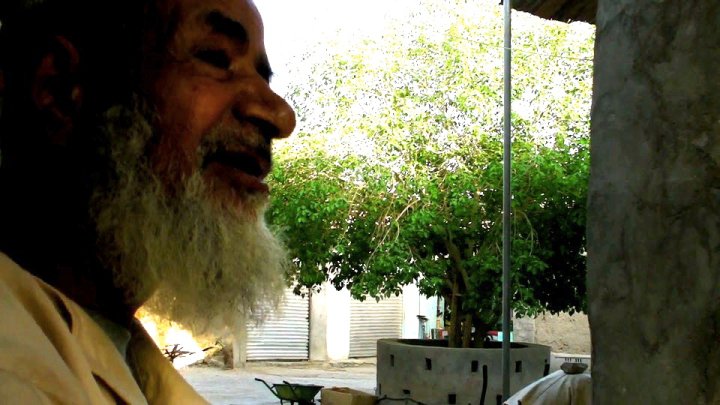
Old man and the magic tree
The tree itself is generally believed to have been a frankincense tree whose sap had been cultivated for millennia and used in religious ceremonies by the likes of King Solomon and Cleopatra.
It is still being used to this day by our local spiritual guide, Moalim Salim, to delve into the realm of the djinn, which the Quran describes as a parallel world of fire without smoke. What stands today in its stead bares little resemblance to the gnarled and twisted monster that spontaneously burst into flame when the locals, believing it to the scourge of the village, cut it down out of fear.
The flying mosque
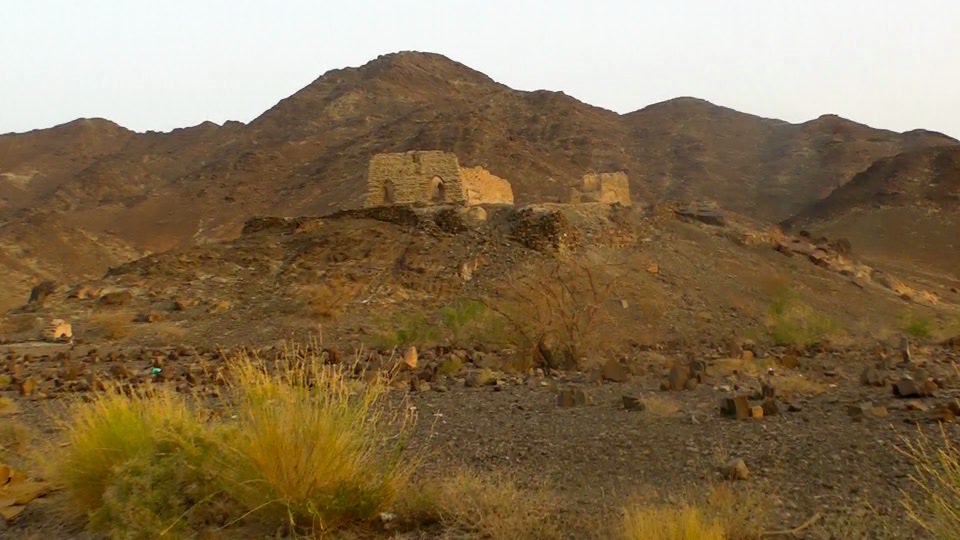
On the other side of the 12 kilometer fortified wall surrounding Bahla is an ancient cemetery of unmarked graves reflecting the austere heritage of Ibadhi Islam. During the Nabahina Dynasty (12th-17th centuries) when Bahla was the capital of Oman, three Sufi mystics took up residence here just outside of the city’s walls to practice their unorthodox sect of Islam, which included saint worship.

Hill of the three saints
These hermits — or saints, as some believed them to be — had tapped into the parallel world of the djinn. It was by this power that the now crumbling remains of the mosque in the middle flew from Rustaq, fully intact.
There from the Hill of the Three Saints, we watched the sun dip behind the jagged outline of the Hajar mountains. Gazing reflectively at the lengthening shadows stretching across the plain of unmarked graves before us, I felt what Carlos Castaneda must have felt after his first meeting with his curandero (spiritual guide), Don Juan, in the deserts of Mexico.
Wondering and wanting to believe in the real possibility of a separate, but seemingly legendary, reality. 
by Baxter Jackson
source matadornetwork

cybershamans (karmapolice) / CC BY-NC-ND 3.0
Share/Bookmark

Tuesday, November 3, 2015

THE CURSED AMETHYST

ALLISON MEIER / 02 OCT 2013

31 Days of Halloween: On Atlas Obscura this month, we're celebrating Halloween each day with woeful, wondrous, and wickedly macabre tales all linked to a real locale that you can visit, if you dare.
article-imageThe Cursed Amethyst (photograph by the author)
Ever since it was stolen out of India during the Rebellion of 1857, this amethyst has brought its owners nothing but despair and devastation. Known as the Cursed Amethyst or, in a bit of a misnomer, the Delhi Purple Sapphire, the stone now resides in the Vault of the Natural History Museum in London alongside such other precious stones as a Martian meteorite and a "medusa" emerald. Its last owner had it locked away within seven different boxes in a bank safe, where it was not to be removed until three years after his death. 
A Bengal cavalryman named Colonel W. Ferris is said to have brought the amethyst to England after it was stolen out of the Temple of Indra in Kanpur. Yet the beautiful violet stone's sinister nature was soon manifested when he lost just about everything he owned and his health deteriorated. The same misery happened to his son who inherited the stone, so he gave it to a friend who subsequently committed suicide. In an unsettling twist, that friend had willed the stone back to the son who found the amethyst returned to him now with a body count to its legend. 
article-imageEdward Heron-Allen (via Wake Forest University Library)
In 1890, Edward Heron-Allen received the stone. Heron-Allen was an ambitious man with an insatiable quest for knowledge, having written books on violin-making, palmistry, and translations of Arabic literature. Yet he soon found himself rattled by a series of disasters. Perhaps not making the connection to his recent acquisition, he gave the stone to a friend who was a singer who suddenly found "her voice was dead and gone," and she never sang again.
Desperate to be rid of the thing, Heron-Allen tossed it into Regent's Canal. Yet three months later, after having been rescued from the depths by a dredger, a dealer gave it back to him. Heron-Allen declared the amethyst "cursed and stained with blood" and he had it secreted away in his bank vault within seven locked boxes.
Three years after his death in 1943, as he'd instructed, his daughter unlocked the amethyst and gave it to the museum, although accompanied by a letter that cautioned against the lilac stone's history of evil, reportedly reading: "Whoever shall then open it, shall first read out this warning, and then do as he pleases with the jewel. My advice to him or her is to cast it into the sea."
Hall leading to the Vault where the amethyst is held at the museum (photo by the author)
The amethyst went on display in the Natural History Museum in 2007, set within a ring of silver with two scarab beetle beads decorating one end. Yet some believe the curse has yet to fade. Curator Richard Savin states in this Museum Secrets video from the History Channel that on coming with the amethyst from a symposium of Heron-Allen Society: "we drove through the most amazing storm we'd ever witnessed. Lightning was flashing on both sides of the car and my wife was shouting at me: throw that damn jewel away, you shouldn't have brought it!" Anytime he's attempted to attend a subsequent meeting he's gotten violently ill. Of course, he notes, it could all be a coincidence.
CURSED AMETHYST: NATURAL HISTORY MUSEUM, London, England

source atlasobscura.com


cybershamans (karmapolice) / CC BY-NC-ND 3.0 Share/Bookmark

Sunday, August 16, 2015

Admiral Richard E Byrd - Hollow Earth Video Interview

Thursday, July 23, 2015

MISTERELE CAPELEI ROSSLYN

Capela Rosslyn

Istorie sau mitologie? Aflata la cateva mile dinstanta de Edinburgh, initial cunoscuta drept capela Sfantului Matei, capela Rosslyn ascunde multe secrete...
Pentru pasionatii de mistere si chiar pentru orice turist curios, capela a devenit in ultimii ani, o veritabila Mecca.

Constructia a fost ridicata de printul de Orkney, Sir William St Clair (dupa unii Sinclair), in 1446. De fapt, ea constituia doar o parte dintr-un vast ansamblu religios, proiectat a avea, in final, forma unei cruci, ansamblu care nu a fost insa niciodata finalizat. Printul de Orkney a murit in 1484, fiind inhumat in interiorul capelei iar urmasii sai nu au mai vrut sa continue lucrarea, care deja aproape ii secatuise financiar.

Reforma brutala impusa de Henric al VIII-lea a dus la distrugerea altarului capelei, in 1592 si de atunci pana prin secolul 18, cladirea a ramas in parasire, ruinandu-se treptat. Trupele lui Oliver Cromwell au folosit-o drept grajd dar s-au ferit sa o distruga, asa cum au facut cu alte edificii catolice. Abia in 1736, un urmas al clanului St Clair, James, va face unele reparatii, refacand complet acoperisul capelei. Un secol mai tarziu, arhitectul David Bryce va intreprinde reparatii capitale, la comanda lui James Alexander, al treilea conte de Rosslyn.

Capela a fost descrisa, pe drept cuvant, drept „o tapiserie in piatra”, fiind una dintre cele mai impresionante constructii din piatra ale Europei, faimosul „stalp al ucenicului” reprezentand o capodopera a sculpturii medievale. Invaluit intr-un total mister pentru profanii, pentru orice initiat transmite un mesaj cat se poate de clar...
Legenda acestuia este interesanta …se spune ca mesterul, nestiind cum sa-l sculpteze, a plecat la Roma, sa caute inspiratie in bisericile de acolo. 

La intoarcere, insa, a gasit stalpul minunat impodobit, de catre un ucenic de-al sau. Invidia i-a luat atunci mintile batranului mester, care l-a lovit cu ciocanul in cap pe ucenic, cu atata putere incat i l-a zdrobit! Altii sustin ca ar fi fost de fapt un sacrificiu voit al tanarului ucenic, pentru a asigura astfel durabilitatea constructiei – ideea este adesea intalnita in folclorul medieval, vezi legenda Mesterului Manole. Indiferent de ce s-a intamplat insa, cert este ca asasinatul produs l-a determinat pe episcopul de St Andrew sa ceara Papei amanarea consacrarii capelei. 

Una dintre sculpturile din capela infatiseaza chiar scena uciderii ucenicului, care apare sub forma unui tanar cu fruntea brazdata de o taietura adanca.

Este evident faptul ca printul de Orkney a avut legatura cu ordinul Templierilor, chiar daca acesta fusese desfiintat, oficial, in urma cu mai bine de un secol si jumatate. Nu e intamplator, din acest punct de vedere, ca peste cateva veacuri, William Sinclair de Rosslyn, un stranepot al printului, a devenit primul Mare Maestru al Lojei Scotiene. 

Este insa oare capela locul unde ar fi fost ascuns Sfantul Graal, cea mai de pret relicva a crestinatatii?
Cavoul in care se afla ramasitele pamantesti ale celor din clanul Sinclair ar putea oferi un raspuns la aceasta intrebare, dar el nu a mai fost deschis de cateva secole. Sub bisericuta, arheologii si istoricii au descoperit, cu ajutorul tehnologiei cu ultrasunete, o sala boltita care nu are nici o intrare.

 Nu au sapat in podeaua capelei, pentru ca le-a fost interzis, motiv pentru care s-au intensificat speculatiile ca aici ar fi ascuns nu numai Sfantul Graal, ci si Chivotul Legii (pe care Moise i l-a daruit lui Aaron) sau chiar capul Sfantului Ioan Botezatorul.

Enigmele nu se opresc aici, caci capela, o reprezentare simbolica a templului lui Solomon din Ierusalim, pare sa ofere indicii despre un contact cu Lumea Noua inainte ca genovezul Columb sa fi ajuns acolo (pe unele sculpturi apar cactusi si stiuleti de porumb, plante necunoscute pe atunci europenilor).

Robert Lomas si Christopher Knight, cei doi autori ai best-seller-ului „Secretul lui Hiram”, sustin ca zidul de apus al capelei de la Rosslyn ar fi de fapt o copie a Zidului Plangerii de la Ierusalim. Una dintre inscriptii atrage atentia: Forte est vinum fortior est rex fortiores sunt mulieres super omnia vincit veritas (Vinul e puternic, regele e mai puternic, femeile sunt si mai puternice, dar adevarul ii biruieste pe toti).

Timp de sute de ani, atat expertii cat si simplii vizitatori au incercat sa rezolve enigma sculpturilor din interiorul capelei. In timp ce unii sunt de parere ca acestea ascund indrumari catre o comoara ascunsa, compozitorul Stuart Mitchell sustine ca a rezolvat o parte dintre aceste enigme. El crede ca tavanele ornate cu arcuri sculptate reprezinta de fapt un cod al unei muzici medievale.

 Tatal sau, Thomas Mitchell, si-a petrecut 20 de ani incercand sa rezolve codul acestor ornamente si acum, Stuart, interpretand descoperirile tatalui sau, a obtinut o partitura, intitulata "The Rosslyn Motet". Cei doi spera ca muzica, atunci cand este interpretata la instrumente medievale va rezona si va dezvalui secretul din piatra.

"Simbolismul din capela Rosslyn vorbeste despre o civilizatie pierduta pentru noi, civilizatie care se pare ca detinea radacini ale tuturor mecanismelor Universului" a declarat Mitchell.

Muzica in sine, potrivit autorului, este un amestec de "melodii celtice plus imnuri antice si un soi de muzica crestina ". Cei doi sunt de parere ca acele note nu au fost sapate in piatra numai pentru a inregistra o piesa muzicala, ci ca acestea pot dezvalui un secret medieval. Exista evident si voci care ii contrazic pe cei doi, cum ar fi directorul Edinbrgh Symphonia, care crede ca este "doar o farsa dusa la extrem, cei doi dorind sa o ia pe urmele lui Dan Brown".

Pe langa cei care considera ca edificiul de la Rosslyn ar reprezenta un mesaj cifrat, sculptat in piatra, exista si sceptici, ce nu vad pe peretii capelei cavaleri eretici si secrete stravechi, ci o marturie asupra geniului la care ajunsesera mesterii zidari ai evului mediu.

Romanele lui Dan Brown sunt considerate a fi nu doar cele mai vandute, dar si cele mai influente carti ale ultimilor ani. Ingredientele lor - crime, mistere, profetii, indicii enigmatice, au adus in atentia cititorilor de pretutindeni o problematica de care odinioara se interesau doar savantii: secretele cavalerilor templieri.
http://www.tjmitchell.com/

SURSA TEMPLULMASONIC

cybershamans (karmapolice) / CC BY-NC-ND 3.0
Share/Bookmark

Related Posts Plugin for WordPress, Blogger...

Share

Twitter Delicious Facebook Digg Stumbleupon Favorites